Tuesday, July 5, 2011

American Patriotic Triva, Part 2; Let's Hear It For the Fourth of July!!


A day late for more patriotic trivia but there's lots to go around. Here's a few more facts about why it's great to be an American!

American Patriotic Towns and Cities

  • 31 places nationwide have "liberty" in their name. The most populous one is Liberty, Missouri. Iowa, with four, has more towns than any other state.
  • There is a small town named Patriot in Indiana with a population of roughly 200 people.
  • Five places have the name "freedom." Freedom, California has the largest population
  • Eleven places have "independence" in their name. The largest city with the word "Independence" is Independence, Missouri
  • There are five towns in the country using the name 'America' with the most populous being American Fork, Utah.

Flag Etiquette and Trivia
  • The American flag should be displayed between sunrise and sunset, unless there is a light to shine on the flag in order to illuminate it in darkness. In that case, it can be on display all day and night. However, the flag should be taken in during inclement weather.
  • The flag's folded, triangular shape represents the tri-cornered hats of the colonial soldiers during the Revolutionary War
  • The proper method of disposal of a tattered, worn flag is usually by burning.
  • The American flag should never meet the ground, the floor, or water.
  • An upside-down American flag is used to signal distress.
  • The first American flag look like had 13 stripes and 13 stars.
  • $3.2 million American flags were imported in 2010 with more than half of this amount was for U.S. flags made in China.
  • 50 U.S. flags are flown 24 hours a day at the Washington Monument in Washington DC. Other places where American flags are flown continuously include Fort McHenry in Baltimore, Maryland; the United States Marine Corp Memorial (Iwo Jima) in Arlington, Virginia; on the Battle Green in Lexington, Massachusetts; and over the White House in our nation's capitol.
The Liberty Bell
  • After being ordered from England and arriving at Independence Hall in February 1753, the bell was hung on March 10, 1753. The sound was tested for the first time then, and because of the flaws in the casting, it cracked.
  • The Liberty Bell was rung on July 8th to announce that the Declaration of Independence had been adopted.
  • About 1.5 million tourists visit the Liberty Bell every year.
The Declaration of Independence

  • The Declaration of Independence signed in Philadelphia.
  • The Declaration of Independence starts with 'When in the course of human events…'
  • John Hancock's signature on the Declaration of Independence is the largest.
  • In 1776, when the Declaration of Independence was adopted, there were 1.5 million people in the colonies.
  • Delegates didn't begin signing the Declaration of Independence until August 2, 1776.
  • Right after the Liberty Bell rang in Independence Hall, Colonel John Nixon read the Declaration of Independence to the public for the first time.
  • The Signers of the Declaration of Independence were: Connecticut: Roger Sherman, Samuel Huntington, William Williams, Oliver Wolcott // Delaware: Caesar Rodney, George Read, Thomas McKean // Georgia: Button Gwinnett, Lyman Hall, George Walton // Maryland: Samuel Chase, William Paca, Thomas Stone // Massachusetts: Charles Carroll, John Hancock, Samuel Adams, John Adams, Robert Treat Paine, Elbridge Gerry // New Hampshire: Josiah Bartlett, William Whipple, Matthew Thornton // New Jersey: Richard Stockton, John Witherspoon, Francis Hopkinson, John Hart, Abraham Clark // New York: William Floyd, Philip Livingston, Francis Lewis, Lewis Morris // North Carolina: William Hooper, Joseph Hewes, John Penn // Pennsylvania: Robert Morris, Benjamin Rush, Benjamin Franklin, John Morton, George Clymer, James Smith, George Taylor, James Wilson, George Ross // Rhode Island: Stephen Hopkins, William Ellery // South Carolina: Edward Rutledge, Thomas Heyward, Jr., Thomas Lynch, Jr., Arthur Middleton // Virginia: George Wythe, Richard Henry Lee, Thomas Jefferson, Benjamin Harrison, Thomas Nelson, Jr., Francis Lightfoot Lee, Carter Braxton

How we celebrate
  • Fireworks were invented in China during the 12th century in order to ward off evil spirits. The United States imports fireworks from China every year for 4th of July celebrations. The value of fireworks imported from China was approximately $37 million in 2010.
  • More than 81 million Americans say they have taken part in a barbecue last year with most of these events taking place on the Fourth of July.
  • Although there is no fixed menu for the celebration of the Fourth, traditional favorites are hamburgers and hot dogs, chicken, ribs, garden salads, potato salad, chips, watermelon and apple pie. Over 150 million hot dogs are consumed on each 4th of July.

Miscellaneous Trivia
  • The star of the 1996 movie Independence Day was Will Smith.
  • The Statue of Liberty is 151 feet tall.
  • The national bird is the bald eagle, even though Benjamin Franklin wanted the turkey.
  • The national flower is the rose.
  • Presidents James Monroe, Thomas Jefferson, and John Adams each died on a 4th of July.Calvin Coolidge, the 30th President, had a July 4th birthday.
  • The 4th of July become a national holiday in 1941.
  • Francis Scott Key wrote our national anthem.

Monday, June 27, 2011

Refuting the Notion: 'Nothing Good Ever Came Out of a Can'; Crab Cakes Make a Great Summer Entree; Read the Labels!


Let me say up front that I was never a big fan of 'Everybody Loves Raymond.' Not that it wasn't funny because it clearly was. But more because I thought the family was oftentimes over-the-top dysfunctional and sometimes if you think about real-life cases (the Casey Anthony clan, for example) it's not all that much to laugh about.

Nevertheless, my husband and I were faithful viewers of the show for the nine years it ran on CBS (1996 to 2005). One of my favorite episodes called 'The Can Opener' came in the beginning of the fourth season. The storyline was that cooking-challenged Debra purchased a deluxe can opener that cost more than Ray thought a can opener should. As was usually the case, Marie got involved criticizing Debra for cooking with canned goods and eliciting the comment that I used in my headline "Nothing good ever came out of a can.'

I tend to agree with Marie, objecting mostly to the sodium content in most canned foods, but I decided to use a recently purchased can of crabmeat to make crab cakes for dinner tonight. We had them recently in a restaurant in Patchogue, Long Island and I put them on my list of things to try this summer. I had a good recipe that I couldn't locate so I peeled the label off my can of Bumble Bee Fancy Lump Crabmeat to see if there was one inside. Many canned goods have recipes hidden there as an added bonus. Take that Marie!!

Sure enough, there was a nice and easy recipe for Bite Sized Crab Cakes just waiting to be tried. I had all of the ingredients too but this recipe called for three 6 oz. cans of crabmeat. I had only one. I adjusted the ingredients but will give you the original as it appears on the can's label. I'm going to make these again for appetizers this weekend at a family gathering. I added a dollop of goat cheese to mine but tartar sauce is probably the way to go.

Though this is a fried entree, there are lots of ways to compensate making it a bit more heart-healthy. See the notes I placed in the text.

Bite Sized Crab Cakes
Ingredients
Three 6 oz. cans of crab meat (I used Bumble Bee)
2 tablespoons Dijon mustard
1/4 cup diced onion
1/2 cup cracker crumbs (use whole grain crackers)
3 tablespoons mayo (use the light variety)
1 tablespoon regular mustard
1/4 teaspoon freshly ground pepper
dash of Worcestershire sauce
1/2 cup green peppers diced
2 large eggs
Butter for frying (use a light butter)

Directions
  • Combine all ingredients except for butter in large bowl.
  • Mix well then shape into 2" rounds, flattening slightly.
  • Melt butter in skillet over medium heat.
  • Add cakes in batches, frying both sides until golden.

Thursday, June 23, 2011

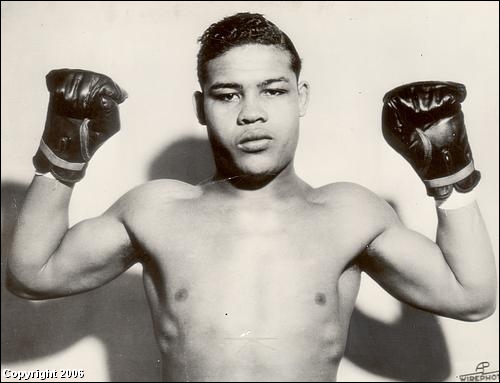
Days Gone By: New York, Madison Square Garden, Joe Louis, Joey Archer and The Fighting Irish...And The Winner Is....


Yesterday in 1937 Joe Louis, pictured above, knocked out James J. Braddock in a boxing match in Chicago, Illinois. The bout lasted eight rounds and Louis, the Brown Bomber, was announced as the world heavyweight boxing champion. On the same date, exactly one year later, Louis knocked out Germany’s Max Schmeling in the first round, at Yankee Stadium. Joe Louis retained the world heavyweight boxing crown until he announced his retirement on March 1, 1949. That’s a total of 11 years, 8 months and 7 days ... and 30 matches to retain the title.

But this isn't a post about Joe Louis or boxing, something I know very little about. But it made me think about a relative of my family who was involved in the sport to some success back in the 60s.

Joey Archer was my mother's cousin. Born in New York City in 1938 he began his career in 1956 when he was 18 years of age. His brother Jimmy was his manager. Freddy Brown was his trainer. My mother was a few years older and was tasked with babysitting for them on occasion. By her account they were a' handful' but their wild behavior probably served them well in the ring. “Irish” Joey Archer began his career, and his quest for achieving boxing success by fighting mostly in New York and Texas venues where he was a winner in his first 30 fights. Notably he beat Don Fullmer by a decision. Fullmer was a highly ranked boxer. This win earned Joey a date against Puerto Rican contender Jose “Monon” Gonzalez, who handed him his first defeat in a close decision. In a rematch two months later, Joey came out on top in a decisive victory.

After that, "Irish" Joey had 15 consecutive wins against some of the Middleweight division’s top fighters, including England’s Mick Leahy, Denny Moyer, Argentina’s Farid Salim, Canada’s Blair Richardson, Holley Mims, Rubin “Hurricane” Carter, and his most impressive career win, against future Hall-of-Famer and three time World champion Dick Tiger.

The final win in the streak was against “Sugar” Ray Robinson in what would be the last fight of Robinson’s illustrious, Hall-of-Fame career. Having reached the top of the Middleweight division, Archer suffered an unexpected, close split decision loss to the ranked Don Fullmer.

Joey Arch fight Emile Griffith for the 
Middleweight Title
Nevertheless, Joey earned a title challenge against Virgin Islander and Middleweight champion Emile Griffith based on his impressive winning streak. The title fight took place in Madison Square Garden on a steamy and hot July night in 1966. I remember my father and uncle went as did many of my mother's cousins. By all accounts, the fight was hard fought and a close contest. After 15 rounds the ring announcer Johnny Addie announced the decision. “The winner, by MAJORITY decision, and still champion… Emile Griffith!!! Six months later, Archer would again fight Griffith for the Middleweight title, and would once again taste defeat in a very narrow, controversial decision. 

“Irish” Joey Archer announced his retirement from boxing after the disappointment of these close losses to Emile Griffith. He ended his career with a record of 45 victories (with 8 by KO) and only 4 defeats. Although never having captured a world title, Archer’s excellent boxing skills earned him induction into the “World Boxing Hall of Fame” in 2005. He is currently on the eligibility list of the “International Boxing Hall of Fame” making him eligible for induction into that prestigious organization.

It must have just been the times because our family, at least as far as I know, never produced another athlete with pugilistic skills. In fact, the men in our family are more apt to negotiate their way out of a confrontation than to engage in 'fisticuffs'. The women? Well, we've been known to resort to 'non-truth telling' to extricate ourselves from any possible altercation. The days of the Irish fighters are long gone but their style and spirit captured in these notes from a writer at the time of the fight:
"Joey's style—move, jab, think, defend— has always belonged to the Irish. Stand-up Irish fighters they called them in another time, and even now in certain musty old saloons in New York their yellow photographs hang high on the wall behind the long, stained bars. The legend is Archer's appeal, and from the crowd's standpoint it made his first fight and second fight with Griffith two of the most galvanic nights in recent Garden history. Archer, however, contends that his style is not appreciated by ring officials today, that it has cost him in two fights with Griffith. Perhaps, but Archer—12 pounds heavier and an inch taller—has never stepped out and handled Griffith, technically or physically."

And from Pete Hamill:
"In the years after [1950s middleweight contender] Joey Archer, there was no longer any need for Irish fighters to act out scenarios of courage, ambition, endurance and the ability to absorb pain in order to triumph. The long tale of the Irish-American, which began with such deprivation and turmoil in the 19th century, had become a different story. There was nothing to prove. We had our American president. We had our splendid novelists. Today, we have our company presidents and our chairmen of banks, our teachers and scholars. In that sense, we do have something to teach all those who came after us, including the new immigrants. In spite of everything, the Irish the Irish won all the late rounds." 


A more recent photo of Joey Archer.


Tuesday, June 21, 2011

Summer! Welcoming the Season With Two New Recipes, One Old Recipe and Two Poems; Lazy, Hazy, Crazy Sounds Good To Me

The lazy, crazy, hazy days of summer have finally arrived and I won't complain if summer 2011 fits the title of the 1963 Nat King Cole hit tune. Winter was too cold and seemed endless. Spring was too rainy and seemed endless. Summer if we're lucky might seem endless but somehow I suspect it will pass all too quickly.

Vacation plans have been made, weekends are mostly booked and I have a stack of must-read books for entertainment. A couple of promising movies are due to open (and by that I mean "Cars 2"!) and our backyard deck is officially open for business.

Last weekend we had guests for dinner and I served a sangria that I made last year. I'll repeat that recipe because everyone seems to enjoy it...and it's easy! Tonight we had a lemony summer potato salad and string beans with tomato and red onion. The recipes follow.

But first the poems, two favorites, one by Shakespeare and the other, Robert Louis Stevenson.

Shall I compare thee to a summer's day?
(Sonnet 18) by William Shakespeare

Shall I compare thee to a summer's day?
Thou art more lovely and more temperate.
Rough winds do shake the darling buds of May,
And summer's lease hath all too short a date.
Sometime too hot the eye of heaven shines,
And often is his gold complexion dimmed;
And every fair from fair sometime declines,
By chance, or nature's changing course, untrimmed;
But thy eternal summer shall not fade,
Nor lose possession of that fair thou ow'st,
Nor shall death brag thou wand'rest in his shade,
When in eternal lines to Time thou grow'st.
So long as men can breathe, or eyes can see,
So long lives this, and this gives life to thee.

At the Sea-Side
By Robert Louis Stevenson


When I was down beside the sea
A wooden spade they gave to me
To dig the sandy shore
My holes were empty like a cup.
In every hole the sea came up
Till it could come no more.

Summer Potato Salad
Note: I found this a bit lemony for my taste but light and perfect for a summer side dish. I might cut back on the zest next time around but will see how it tastes after a night of refrigeration.

Ingredients
1 1/2 pounds red new potatoes, sliced 1 inch thick
1 teaspoon lemon zest
1/4 cup fresh lemon juice (from 2 lemons)
Coarse salt and ground pepper
/2 cup coarsely chopped fresh herbs, such as a combination of basil, parsley, and tarragon
2 tablespoons extra-virgin olive oil


Directions
  • On stove top, steam potatoes tossing occasionally, until tender, 10 to 12 minutes.
  • In a medium bowl, place lemon zest and juice; season with salt and pepper. Transfer potatoes to bowl and toss with lemon juice. Refrigerate until cool, at least 1 hour.
  • Toss herbs and oil with cooled potato mixture; season with salt and pepper.


String Beans With Tomatoes and Red Onion

Ingredients
1 pound whole fresh string beans
Extra-virgin olive oil, for drizzling
1/2 lemon, juiced
Coarse salt and pepper

Directions
  • Steam green beans for 3 or 4 minutes. 
  • Thinly slice onion and tomatoes .
  • Cold shock beans by running under icy water and drain well. 
  • Place beans in a bowl and combine with onions, cucumber and tomato. 
  • Drizzle extra-virgin olive oil and the juice of 1/2 lemon. 
  • Season with coarse salt and pepper, to taste.
Rosé Sangria
Mix together:
1 bottle inexpensive rosé
1 cup white cranberry juice
5 ounces Framboise
1 tablespoon sugar
sliced fruit such as blueberries, strawberries, oranges, watermelon

Serve cold on ice

Monday, June 20, 2011

NBC Rewrites History: Undoing A Congressional Resolution During the U.S. Open; Did They Think No One Would Notice?


Like many Father's Day gatherings, ours was permeated by the U.S. Open Golf Tournament held this year at the Congressional Country Club in Bethesda, Maryland. Not my favorite way of spending a perfect sunny family day but because my husband is a huge golf fan, the match became the main event.

Because of the club's proximity to the Washington D.C., NBC (the network broadcasting the event) was motivated to produce a patriotic montage that was played at the beginning of the coverage. The film, attached here, had alternating and moving scenes of schoolchildren reciting the Pledge of Allegiance, soldiers, flags, past Open winners ...well, you get the picture...very American! Sounds great, right?


But yesterday and today, a brouhaha developed when it became apparent that the words "under God, indivisible" were omitted. Not once. Twice!

Irate calls made to the network yesterday prompted NBCs host Dan Hicks to read an apologetic statement:
"It was our intent to begin our coverage of this U.S. Open championship with a feature that captured the patriotism of our national championship being here in our nation’s capital for the third time. Regrettably, a portion of the Pledge of Allegiance that was in that feature was edited out. It was not done to upset anyone and we’d like to apologize to those of you who were offended by it."
And today, an official apology fro NBC brass was released calling the decision to omit "a bad one ".

In the letter, NBC elaborated:
We understand your concern over the beginning of our U.S. Open coverage on Sunday.
We are aware of the distress this has caused many of our viewers and are taking the issue very seriously.
Unfortunately, when producing the piece - which was intended to capitalize on the patriotism of having our national championship played in our nation's capital - a decision was made by a small group of people to edit portions of the Pledge of Allegiance. This was a bad decision.
As soon as management became aware of this decision and the controversy it justifiably created, it immediately took steps to correct it resulting in an on-air apology provided by NBC Sports' lead golf commentator Dan Hicks. 
It was not the intent of NBC to upset anyone and we sincerely apologize to anyone who was offended.
The Pledge of Allegiance was written in 1892 by a Baptist minister Francis Bellamy (right). Originally published in a children's magazine called "The Youth's Companion" it was intended to be a part of our nation's public school celebration of the 400th anniversary of Christopher Columbus's arrival in the Americas. The original pledge read:
I pledge allegiance to my Flag and the Republic for which it stands, one nation indivisible, with liberty and justice for all.
Bellamy wanted the pledge to be quick, recited in 15 seconds. That same day,  Bellamy, Congress and President Benjamin Harrison announced a national proclamation making the public school flag ceremony the center of the national Columbus Day celebrations.

Louis A. Bowman, an Illinois lawyer and Presbyterian, was the first to initiate the addition of "under God" to the Pledge. He said that the words came from Lincoln's Gettysburg Address, though not all versions of the Gettysburg Address contain the words "under God". It is thought that Lincoln may have deviated from his prepared text and inserted the phrase when he said "that the nation shall, under God, have a new birth of freedom."

In 1951, the Knights of Columbus began including the words "under God" in the Pledge of Allegiance and adopted a resolution to amend the text of the Pledge of Allegiance recited at the opening of each of their meetings. Over the next two years, the idea spread and in August of 1952, Knight's Council adopted a resolution urging that the change be made universal. This resolution was sent to the President, the Vice President and other Washington officials but attempts to make a national amend the Pledge failed.

In 1954, President Eisenhower was sitting in Abraham Lincoln's pew when the church's pastor, George MacPherson Docherty, delivered a sermon based on the Gettysburg Address arguing that the nation's might lay not in arms but its spirit and higher purpose. He noted that there was something missing in the pledge and cited Lincoln's words "under God" as defining words that set the United States apart from other nations.

President Eisenhower had been baptized a Presbyterian just a year before and responded enthusiastically to Docherty in a conversation following the service. Eisenhower acted on his suggestion the very next day and by February of that year a bill was introduced in Congress who passed the necessary legislation. Eisenhower signed the bill into law on Flag Day, June 14, 1954 and the phrase 'under God" was incorporated into the text of the Pledge of Allegiance.

An Congressional action, in place for 57 years, undone by an act of NBC yesterday.

Hmmmmmmmm

Thursday, June 16, 2011

A Timeline of United States Political Scandals; From Jefferson to Weiner, History Repeats Itself in a Most Unfortunate Way; "Ma, Ma, Where's My Pa?"

AP Photo
Today, Rep. Anthony Weiner, A New York Democrat would become the third member of the U.S. Congress this year to step down because of a sex scandal. Unfortunately, this is a recurring problem with our elected officials. Here's a rundown of some of the most shocking:


1802: Thomas Jefferson (left)  was rumored to have had an affair with his slave Sally Hemings. DNA tests of their descendants confirmed it in 1998.

1884: Grover Cleveland won his election despite opponents making an issue of his illegitimate child with chants of " Ma, ma, where's my pa"? Gone to the White House, ha, ha, ha."
1903: The Speaker of the House, David Henderson (right) (R-Iowa), was forced to resign over his sexual relationship with the daughter of a senator. Henderson never said why he was quitting, and neither did the press.

1974: Rep. Wilbur Mills (D-Ark.), (pictured below left)  the chairman of the House Ways and Means Committee was forced to resign s chairman after cavorting with a stripper with the stage-name Fanne Foxe (below, left). In 1976 he decided to not seek another term after a 38 year career in the Congress.

1976: Rep. Wayne Hays (D-Ohio) resigned as chairman of the Democratic Congressional Campaign Committee when it was discovered that Elizabeth Ray, a secretary for the House Administration Committee, headed by Hays, was highly unqualified for the $14,000 a year job. Hays later dropped his reelection bid, and finally resigned on September 1.

1976: Rep. John Young (D-Tex.) was accused of making sexual advances to a staff secretary who capitulated for an increase in her salary. He had just been reelected but the scandal wouldn't go away and in 1978 Young was defeated in a Democratic primary runoff.

1976: Rep. Allan Howe was arrested in Salt Lake City on charges of soliciting two policewomen posing as prostitutes. Howe i refused to resign but lost an election to a Republican candidate in the next election.

1978: Rep. Fred Richmond (D-N.Y.) was arrested in Washington for soliciting a 16-year-old boy. Richmond apologized and easily won renomination and reelection. After pleading guilty to possession of marijuana and tax evasion a couple of years later, he resigned his seat.

1980: Rep. Jon Hinson (R-Miss.) admitted during a reelection bid that he had been accused of committing an obscene act at a gay bar in 1976 allegedly to clear his conscience..He won the election but three months later was arrested for attempted oral sodomy in the restroom of a House office building. He resigned in April 1981.

1980: Rep. Robert Bauman (R-Md.) a "pro-family" conservative lost his next election after being accused of committing oral sodomy on a teenage boy in Washington. He pleaded innocent to the charges.

1981: Rep. Thomas Evans (R-Del.) was not reelected after he and three other House members shared a cottage during a 1980 vacation in Florida with Paula Parkinson, a lobbyist who later posed for Playboy magazine.

1983: Reps. Dan Crane (R-Ill.) and Gerry Studds (D-Mass.) were accused by the House ethics committee of having sexual relationships with congressional pages – Crane with a 17-year-old female in 1980, Studds with a 17-year-old male in 1973. The full House voted to censure the two, the first time that ever happened for sexual misconduct. Crane was voted out in the next election but Studds stayed in office until the mid-90s.

1987: Rep. Ernie Konnyu (R-Calif.) was accused of sexually harassing two former aides. He lost in the primary of the next election.

1987: Colorado Sen. Gary Hart announced his second Democratic presidential run in 1987, after news outlets report he was having an extramarital affair with 29-year-old model Donna Rice

1988; Sen. Brock Adams (D-Wash.) was accused by several women over the years of sexually harassing them. He ended his 1992 campaign after the accusations increased. He maintained his innocence.

1988: Rep. Jim Bates (D-Calif.)was accused by aides of making sexual advances toward female staffers. The story came too close to Election Day to damage Bates, who won easily. When the ethics committee forced him to make a formal apology, he lost his next election.

1989: Rep. Donald "Buz" Lukens (R-Ohio) was accused by the mother of a Columbus teenager that Lukens had been paying to have sex with her daughter since she was 13. He resigned in October of the followin year after being accused of fondling a Capitol elevator operator.

1989: Rep. Gus Savage (D-Ill.) was accused of fondling a Peace Corps volunteer while on an official visit to Zaire. Savage called the story a lie and was reelected in 1990, but finally ousted in the 1992 primary.

1989: Rep. Barney Frank (D-Mass.) confirmed that he hired Steve Gobie, a male prostitute to live with and work for him in his D.C. apartment. The Boston Globe, among others, called on Frank to resign, but he refused. Attempts to expel or censure Frank failed and he is still in Congress today.

1990: Rep. Arlan Stangeland (R-Minn.) had made several hundred long-distance phone calls on his House credit card to or from the residences of a female lobbyist. Stangeland was married with a large family acknowledged the calls and said some of them may have been personal but not romantic. He was voted out in the next election.

1991: Sen. Charles Robb (D-Va.)  married to Lyndon Johnson's daughter, was accused of having a extra-marital affair but said all that took place was a massage over a bottle of wine. Robb won his next election after the Republians nominated Oliver North to run against him.

1992: Sen. Daniel Inouye (D-Hawaii) was accused of sexual harassment by his hairdresser. He denied the charges and the Senate Ethics Committee decided to drop the investigation because the accusers wouldn't participate in an inquiry.

1992: Sen. Bob Packwood (R-Ore.) allegedly sexually harassed 10 female staffers. He denied the charges. When more women came forward with stories, there were calls for his resignation. In September of 1995 when, faced with expulsion, Packwood announced his resignation.

1992: Gennifer Flowers revealed a 12-year affair with Arkansas Gov. Bill Clinton to a tabloid newspaper shortly before the Democratic primaries.

1994: Rep. Mel Reynolds (D-Ill.) was indicted on charges of having sex with a 16-year-old campaign worker and then pressuring her to lie about it. Reynolds denied the charges about was convicted on Aug. 22, 1995 of several offenses finally resigned his seat on October 1.

1998: President Bill Clinton (left) admits to having an affair with former White House intern Monica Lewinsky.

2004: New Jersey Gov. Jim McGreevey steps down after disclosing he had an affair with another man.

2006: Republican Representative Mark Foley of Florida resigned after it was disclosed that he had sent sexually suggestive e-mails to male pages.

2008: Republican Senator Larry Craig of Idaho did not run for re-election in 2008 after he was arrested on charges of soliciting sex in an airport men's room.

2008: New York Gov. Eliot Spitzer admitted to having an affair with 22-year-old call girl Ashley Dupre.

2008: Former North Carolina Sen. John Edwards admits he had an affair with former campaign videographer Rielle Hunter during his second presidential run.

2008: Rep.Vito Fossella (R.NY) fathered a 3-year-old love child in an illicit affair with a female retired Air Force officer. He was married with three children and did not run for reelection.

2009: Sen. John Ensign, R-NV, confesses to having an extra-marital affair with a former campaign aide. 

2009: South Carolina Gov. Mark Sanford admitted to having an extramarital affair with his 'soul mate', a woman living in Buenos Aires, Argentina.

2010: Republican Senator David of Louisiana was identified as a client of a prostitution service. He won re-election in 2010 after asking for forgiveness.

2010: Democratic Representative Eric Massa of New York resigned to avoid an ethics probe into alleged sexual misconduct toward a male staffer.

2010: Republican Representative Mark Souder of Indiana resigned in 2010 after admitting that he had an affair with a female staffer.

2011: Republican Representative Chris Lee of New York resigned in February shortly after it was disclosed that he sent a shirtless photo of himself over the Internet to a woman who was not his wife.

2011: Republican Senator John Ensign of Nevada stepped down in May as an ethics committee was wrapping up an investigation into his affair with a former aide and an attempted cover-up.

2011: Former California Governor Arnold Schwarzenegger admits to fathering an illegitimate  child 10 years ago with his housekeeper. He is married to Maria Shriver who has filed for divorce.

....and then there was WEINER....

Wednesday, June 15, 2011

Operation 'Duck and Cover': Let Me Just Say That I'm Glad the 'Bomb' Didn't Drop

Today is the anniversary of the 1955 Eisenhower administration's first annual "Operation Alert" (OPAL) exercise, an attempt to assess the USA's preparations for a nuclear attack. That program must have been  a sign of the times because I can recall ( with some hilarity actually) that in school during the 1950s we were drilled in a 'safety' procedure to protect us should the bomb fall during the hours of 8 A.M. through 3 P.M.. Luckily for all of us, it did not!

Any of us of a certain age will recall hearing a fake alarm being sounded and going under our desks crouched with head down to protect our faces and bodies from nuclear fallout. Riiiiiiiight!!

After Nagasaki and Hiroshima, in the beginnings of the 'cold war', our government felt that there was a very real threat of unfriendly nations (such as the USSR) getting their hands on the materials needed to make an atomic bomb. So when the Soviet Union exploded its first atomic bomb in 1949, the American public was understandably nervous. The defensive response by the US was to deploy a fairly strong layered defense of interceptor aircraft and anti-aircraft missiles but this was a small response compared to the construction of a huge fleet of nuclear bombers. While they were aware of the destruction that our atomic bombs did to the Japanese cities, the public did not know a lot about the dangers of radiation and fallout.

The FCDA commissioned an educational film for children. The producers went to work on a script that would combine live actors and an animated turtle to encourage kids to duck down to the ground and get under some form of cover – a desk, a table or next to a wall – if they ever saw a bright flash of light. The flash would presumably be produced by an atomic blast. The hero of the film was the animated Turtle named Bert who wore a pith helmet and quickly ducked his head into his shell when a monkey in a tree set off a firecracker nearby. The 'Duck and Cover' film was completed in January 1952. The film was shown to educators at a gala premiere screening at a Manhattan movie theatres after which it was distributed to schools around the country by one of the largest educational film distributors.

In 1951, a new Federal Civil Defense Administration (FCDA) was set up to educate – and reassure – the country that there were ways to survive an atomic attack from the Soviet Union and this is where the school involvement came in. Teachers in selected cities were encouraged to conduct air raid drills where they would suddenly yell, "Drop!" and students were expected to kneel down under their desks with their hands clutched around their heads and necks. Apparently, some schools even distributed metal "dog tags," like those worn by World War II soldiers, so that the bodies of students could be identified after an attack.

Many baby boomers like me remember duck and cover drills in their schools but know now that those drills or even fallout shelters probably wouldn't have done much good. In any case, 'duck and cover' stopped somewhere along the way and today the threat of 9-11 style attacks or chemical warfare is even more frightening.

Attached is a link to the 1952  film.

http://www.youtube.com/watch?v=IKqXu-5jw60