Sunday, May 25, 2014

The view from the Woodhull family side of the bay, looking toward the Strong family homestead where messages were passed by hanging petticoats and handkerchiefs on a clothesline.


 #birthdaygiftforahistorybuff
Anna Smith Strong's gravesite in Setauket, Long Island.
My husband is a devotee of history, a James Bond aficionado and has been known in our family as "Mr. Miniseries' ever since the dawn of that genre when 'Rich Man, Poor Man' first appeared on the small screen. So what to give him for his birthday?

This year, an alignment of these pursuits presented a unique opportunity for the perfect birthday present. Since March we've been watching the miniseries 'Turn' on AMC. The plot of this Revolutionary War drama, centers on the "Culper Spy Ring headed by a Long Island farmer Abraham Woodhull. The Culper Ring was organized by Setauket-born Major Benjamin Tallmadge under orders from General George Washington in 1778 when the British occupied New York City and Long Island at the height of the Revolutionary War. Woodhull, together with a group of childhood friends from Setauket formed The Culper Ring and turned the tide in America's fight for independence.

History? Spies? Miniseries? Long Island? I could make this happen!

So off we went this Memorial Day weekend to Setauket on the north shore of Long Island in Suffolk County. The Village of Setauket lies just west of Port Jefferson and this mostly residential area is formed by a series of 'necks' creating inner harbors, bays and ponds just off Long Island Sound. 
When we arrived we discovered that the publicity from the TV show has had some effect on the town. The local historical museum, the Three Village Historical Society (www.threevillagehistoricalsociety.org) has an exhibit (Spies!) featuring the Culper Ring and a bus tour scheduled for Saturday, June 21. We opted for a self drive tour that meandered through the historical area. 
Through the 'miracle' of the cell phone and a sponsorship by The Long Island North Shore Historic Society (LINSHS), we were able to pull over to the side of the road when we spotted specially designated signs. By dialing in, we were treated to interesting historical tidbits retelling the story of the spy ring and the townspeople who made it all happen. One memorable part of the tour was a walking tour of the private cemetery where the Strong and Smith families were buried. Anna Smith Strong, an alleged member of the spy ring and one of the main characters in the show, is buried here along with her husband. Strong family descendants still reside in the area. Abraham Woodhull is buried in the Setauket Presbyterian Church cemetery near the village green. Another church, The Caroline Episcopal Church, has a visible bullet hole from the Battle of Setauket in 1777. Truly, it gave new perspective to the TV show and certainly enhanced our knowledge of the role Long Island played in the War of Independence.
The beautiful Caroline Church with bullet
from the battle of Setauket, 1777. 
Of course, on the ride home, we had some questions. On the tour, we learned that Abraham and Anna drove into Manhattan in their pursuit of 'intelligence gathering.' We wondered how long it would have taken to make the trip in a horse and buggy. This distance is about 60 miles. Back then, a horse could travel about 20-30 miles a day so it might have taken two days and probably involved an overnight stay in a Long Island Inn.
More incredibly, we also learned that one of the local spies would row across the Long Island Sound from Setauket to Connecticut to pass on information to the American militia. Knowing the distance and the unpredictability of those waters, it was without question a heroic task.
On a weekend when we honor those who serve and have served our country, my husband and I were happy to be able to learn more about and acknowledge these early patriots, standing for a moment on the shores and lands where they once stood when our nation was fighting for its independence. 
It was an appropriate gift all around.
Happy Memorial Day to all! 


Saturday, September 15, 2012

A Covertible 'Pinkalicious' Lemonade Stand

This summer I made a lemonade stand.

I teach an art class and learned from some of the girls about a children's book character called 'Pinkalicious'. Apparently Ms. Pinkalicious is a bit of a heroine to the the pre-school and pink-loving set so I sought out some of the books and discovered one about a lemonade stand (pink lemonade of course!) which I purchased to read to the class.

As the program was ending for the summer, I decided to make a lemonade stand where pink cookies, pink cupcakes and the aforementioned beverage would be served to the students as a closing party.

When it comes to construction of any sort in my house, I'm on my own or at least at the mercy of handymen or contractors. The latter are only used on the big jobs for which a simple lemonade stand certainly didn't qualify. Besides, I really wanted to make it myself.

Off I went to Michael's craft store where I purchased 4 wooden crates. My next stop was our local hardware store where I picked up my main tools: glossy white paint, Gorilla glue and staples for my staple gun. I also purchased 4 square staircase dowels that were already painted white. Last stop was Home Goods where I fount a bright pink flower patterned table runner which would serve nicely as an awning.

Back home, I began my 'construction' by gluing the 4 crates together to form a large rectangle. The bottoms of the crates would serve as the front of the stand and the open ends made great shelves to hold supplies. After the glue dried I took my structure outside and painted it glossy white inside and out.

When the paint dried, I glued the posts to the sides, the two front posts positioned lower than the two at the back. I used masking tape to hold the posts in place while the glue dried. When that was done, I was ready to attach the awning which I did by centering it, pulling it tight and staple-gunning it to the posts. I finished it off by painting a decorative lemonade sign that was attached to the front.

I had to admit it was quite lovely as I dressed it up with props, food and lemonade served in kid-friendly sippy cups. The kids loved it! We used it again for my grandaughter's first birthday party.

The best part about the stapled awning is that it's removable. Next week, my twin grandsons are celebrating their 4th birthday. Their party theme is 'Angry Birds' and I decided to refurbish the stand
with a new awning and signage calling it 'The Angry Bird Birthday Bodega'.

Another thought:  since lemonade is passe in the fall...this basic stand could easily be turned into an apple cider stand for a Halloween or Thanksgiving party where kids will be present.

The cost was minimal but the final product was priceless!


Thursday, September 6, 2012

Our 'Uncle' is From Troy, New York

This was really meant to be a Fourth of July post but since that date has passed, I thought this might work just as well given the political convention and election season we're in right now.

This past June, my husband and I were driving to Manchester, Vermont for a business conference. On the way, we passed through the city of Troy, New York located on the east side of the Hudson River a few miles north of Albany.

At one time Troy was known as the Collar City due to its manufacturing shirts, collars, and other textile production. But it might best be known for The Rensselaer School, which later became Rensselaer Polytechnic Institute, founded in 1824. Another institution of higher learning, Russell Sage College, opened in 1916. For me, as we entered the city, I was surprised to see a sign declaring Troy as the home of 'Uncle Sam.' Really? Of course I knew I would investigate.

So here is (allegedly) how that name came about: During the War of 1812, Samuel Wilson, a Troy meat packer, got a job packing his products into barrels and shipping it to the Army. Rations of fresh meat were rare in those days, and when the soldiers asked who supplied it, the answer was "Uncle Sam" because "U.S." was stamped on the meat barrels. "United States" and "Uncle Sam" became synonymous. Sam Wilson, the story goes, was called "Uncle Sam" around Troy because he employed a lot of its residents was friendly and well-liked.

Samuel Wilson, meat packer
The famous image of Uncle Sam was shown publicly on the cover of the magazine Leslie's Weekly, on July 6, 1916, with the caption "What Are You Doing for Preparedness?" The artist was James Montgomery Flagg.  The image shown above is from 1917.  Flagg's image also was used extensively during World War II.

Troy boasts a  memorial near Wilson's long-term residence in that city.  Samuel “Uncle Sam” Wilson, born in 1766,  is undoubtedly Troy’s most famous son. 

Additional Troy Trivia:
Interestingly, Kevin Smith, a contestant on the show 'Who Wants to Be a Millionaire' won the top prize of $1,000,000 by correctly answering the question, "The U.S. icon 'Uncle Sam' was based on Samuel Wilson who worked during the War of 1812 as a what?" The answer was A: Meat inspector.

On December 23, 1823, The Troy Sentinel was the first publisher of the world-famous Christmas poem "A Visit from St. Nicholas" (also known as "The Night Before Christmas" or "Twas the Night Before Christmas"). The poem was published anonymously. 

Tuesday, September 4, 2012

The Daily Suse is Back With a Super-Easy Summer Harvest Side Dish: A Recipe That Won't Corn-swoggle You

It's been almost 10 months since my last blog post. Lots of reasons, no excuses, but 'The Daily Suse' that I started back in July of 2010 after leaving a twenty-year career in the newspaper business, is back!

Astonishingly, in that short time, I have had almost 50,00 readers but in the world of successful blogs, that's a mere drop in the bucket. I'm still amazed at the diversity of readership ranging globally from the United States to India, Brazil, Thailand, Russia and lots more.

But now to explain the luscious-looking cold corn salad in the photo at the top of the page. This Labor Day weekend we had a houseful of company. As usual, I overreached on the menu and was left with 10 unused ears of corn on the cob. A few weekends ago, we were out in the Hamptons for a 'sister-daughter-niece weekend' that has become a bit of a tradition in our family.  Besides reconnecting with each other, we've turned it into an occasion to cook (and yes, drink!) together and try healthy new recipes.

This year, my sister visiting from Florida, discovered (reading a local Long Island magazine) that a former neighbor of my parents had a farm stand in Southhold just north of my sister's Westhampton home. Since we had to buy vegetables, off we went to KK's 'The Farm'  http://www.kkthefarm.com/   where vegetables are not only organically grown but grown using biodynamic practices. This simple-looking farm stand has recieved lots of acclaim for the quality of their produce, their fresh flowers and friendliness of the owners. If you're traveling to the North Fork this fall, perhaps to the many wineries, look for the stand on Route 25 and treat yourself to vegetables grown the way we should expect.

Lots of recipes will follow in coming weeks but today is all about corn since it is plentiful right now. This recipe is an adaptation from 'The Barefoot Contessa,' Ina Garten, (also from the Hamptons) and it is as easy to prepare as it is nutritious. We made it that weekend but today I recreated it using my surplus corn supply!

Corn is known to control diabetes, prevent heart ailments and lower hypertension. It is a rich source of vitamins A, B, E with lots of fibre that helps with the prevention of digestive disorders like constipation, hemorrhoids and colorectal cancer. The antioxidants present in corn also act as anti-cancer agents and prevent Alzheimer’s. A large ear of corn has approximately 123 calories....and.....corn-on-the-cob is always gluten free.


Cold Corn Salad

INGREDIENTS
5 ears of corn, shucked
1/2 cup small onion, diced
3 tablespoons cider vinegar
3 tablespoons good olive oil
4 roasted & marinated red peppers, diced
1/2 teaspoon kosher salt
1/2 teaspoon freshly ground black pepper
1/2 cup fresh basil leaves sliced

DIRECTIONS
1. In a large pot of boiling salted water, cook the corn for 3 minutes until the starchiness is just gone. Drain and immerse it in ice water to stop the cooking and to set the color. When the corn is cool, cut the kernels off the cob, cutting close to the cob.

2. Toss the kernels in a large bowl with the red onions, vinegar, olive oil, salt, and pepper. Just before serving, toss in the fresh basil. Taste for seasonings and serve cold or at room temperature.

Monday, November 21, 2011

Thanksgiving Facts To Chew On; Bearing Beer on the Mayflower; Thomas Jefferson and Ben Franklin Mix It Up Over the Turkey

The First Thanksgiving by Jennie Brownscombe.
This weekend, while visiting our son, daughter-in-law and grandchildren in Dedham, Mass., I proposed a timely visit to Plymouth about a 45 minute drive. The weather was good and the Plymouth website promised a parade with floats, a children's activity tent and a viewing of the famous 'rock' inscribed with the date 1620. After a few delays, the parade started and we had a great viewing spot for our six and four year old grandsons. Bagpipers, fife and drum bands went by and an old green World War 2 bomber flew low over our heads, but just as a float carrying a re-creation of the Mayflower was in sight, a group of marchers fired some rifles repeatedly as part of a demonstration. The boys started screaming and our parade viewing came to a speedy and tearful conclusion.

Guns? I thought pilgrims were a peace-loving people?

While we were there we noticed two different spelling of the word Plymouth...it was also spelled Plimoth when referring to the recreated plantation nearby. Plymouth, it seems, is the more modern spelling. Plymouth is a lovely New England village with beautiful homes sitting cliff side overlooking Cape Cod Bay, worth a return visit perhaps in the spring.

We never did get to see the rock!

Dates to Remember
The first American Thanksgiving celebration was in 1621 in Plymouth, Massachusetts. The pilgrims arrived a year earlier in December 1620.

Thanksgiving Day is celebrated on the fourth Thursday in November in the United States.

Thanksgiving Day is celebrated on the second Monday in October in Canada.

President George Washington issued the first national Thanksgiving Day Proclamation in the year 1789 and again in 1795.

The state of New York officially made Thanksgiving Day an annual custom in 1817.

Sarah Josepha Hale, an editor with a magazine, started a Thanksgiving campaign in 1827 and it was result of her efforts that in 1863 Thanksgiving was observed as a day for national thanksgiving and prayer.

Abraham Lincoln issued a 'Thanksgiving Proclamation' on third October 1863 and officially set aside the last Thursday of November as the national day for Thanksgiving. Before that,  the presidents used to make an annual proclamation to specify the day when Thanksgiving was to be held.

President Franklin D. Roosevelt restored Thursday before last of November as Thanksgiving Day in the year 1939. He did so to make the Christmas shopping season longer and thus stimulate the economy of the state.

Let's Talk Turkey
Toms or male turkeys gobble. Hens or female turkeys make a clicking noise.

North Carolina produces the most turkeys annually.

The turkey was originally domesticated in Mexico and Central America.

Benjamin Franklin wanted the turkey to be the national bird of the United States. But it was Thomas Jefferson who opposed him. It is believed that Franklin then named the male turkey as 'tom' to spite Jefferson.

June is National Turkey Lovers' Month.

Californians are the largest consumers of turkey in the United States.

Since 1947, the National Turkey Federation and the Poultry and Egg National Board have given a turkey to the President of the United States at a White House ceremony. Presidents have been more likely to eat the turkey rather than give it a reprieve. In 1963, President Kennedy, referring to the turkey given to him, said, "Let's just keep him." The first Thanksgiving of President George H.W. Bush was the first time a turkey was officially pardoned.

From 1989 through 2004, the turkeys were given to Kidwell Farm, a petting zoo at Frying Pan Park in Herndon, Virginia. In 2005 and 2006, the turkeys were flown to Disneyland in California where they served as honorary grand marshals for Disneyland's Thanksgiving Day parade. After that, they spent the rest of their lives at a Disneyland ranch.

On November 24, 2010, President Obama gave two turkeys named Apple and Cider a last-minute reprieve. Obama made light of the event. "Let me say that it feels pretty good to stop at least one shellacking this November," he said, referring to the drubbing that Democrats took in the midterm elections, which Obama described as a "shellacking."

Israel consumes the most turkey per year per capita.

The best way to defrost a turkey is in the refrigerator.

Domesticated turkeys cannot fly. Wild turkeys can fly for short distances up to 55 miles per hour and can run 20 miles per hour.

90 percent of American homes eat turkey on Thanksgiving.

50 percent of American homes eat turkey on Christmas.

Turkeys weren't introduced into Europe from the Spanish colonies in South America until 1523. However, by 1524, turkeys, imported from South America, were eaten at the court of King Henry VIII of England.

The skin that hangs from a turkey's neck is called a wattle.

The turkey trot ragtime dance is characterized by a springy walk with the feet well apart and a swinging up-and-down movement of the shoulders.

A mature turkey has about 3,500 feathers.

Minnesota produces the most turkeys annually.


Pilgrims and Indians
The Mayflower left Plymouth, England on September 6, 1620 and sighted land off Cape Cod on November 9, 1620 and first landfall was made November 11, 1620

The voyage from Plymouth, England to Plymouth Harbour  across the Atlantic Ocean is about 2,750 miles, and took 66 days.

The pilgrims sailed on the ship called the 'Mayflower'.

By the fall of 1621 only half of the pilgrims, who had sailed on the Mayflower, survived. The survivors, thankful to be alive, decided to give a thanksgiving feast.

The Pilgrim saga began with a group of religious dissidents who believed it was necessary to separate from the Church of England. Persecuted in England, these "Separatists" moved to Holland in 1607/1608.

The group, joined by other colonists recruited by the venture's financial backers, began the move to America in 1620.


The Wampanoag Indians taught the Pilgrims how to cultivate the land.
Gov. Bradford

The Pilgrim leader, Governor William Bradford organized the first Thanksgiving feast and invited the Wampanoag Indians to the feast. There were about 90 indians present. The feast lasted three days!

The drink that the Puritans brought with them in the Mayflower was the beer.

102 Pilgrims were on board the Mayflower.

The Wampanoag chief's name was Massasoit.

William Penn, who founded the state of Pennsylvania, was a pilgrim.

First Santa float in the Macy's Parade, 1924.
Other Thanksgiving Facts
The annual Macy's Thanksgiving Day Parade tradition began in the 1920's.

The Jewish holiday of Shabuoth or Shavuoth is similar to Thanksgiving. In biblical times the festival was a thanksgiving for the grain harvest. Later tradition associates the holiday with the giving of the Law on Mount Sinai.

Kwanzaa, also similar to Thanksgiving, has its roots in the ancient African first-fruit harvest celebrations from which it takes its name. However, its modern history begins in 1966 when it was developed by African American scholar and activist Maulana Karenga.

The Virgin Islands rejoice in the end of the hurricane season on Oct. 25

At the First Thanksgiving, it was acceptable to spit on the ground, throw bones into the hearth and eat with your hands.

Pumpkin pie was not served at the First Thanksgiving.

The cornucopia (a horn-shaped basket overflowing with fruits and vegetables) is a typical emblem of Thanksgiving abundance that dates to ancient harvest festivals. Many of the images commonly associated with Thanksgiving are derived from much older traditions of celebrating the autumn harvest.

Tuesday, November 8, 2011

Etiquette For Social Situations: Who Goes First in a Revolving Door and the Lost Art of Other Gentlemanly Gestures

Last night my husband and I were in Manhattan for dinner with another couple. As we were entering the hotel where the dinner was to be held, the question came up about who goes first in a revolving door: the man or the woman. I'd never thought about and and promised to investigate. In our case, the husband of the other couple went first and he thought that was correct since males are usually physically stronger, and have an easier time getting the door spinning.

He was exactly right according to tradition and Peggy Post (great granddaughter-in-law of the venerable Emily Post) and while this is still a courteous thing to do, some of today's women would prefer to get the door moving themselves not to appear helpless. It's OK to do either but not OK to embarrass a man or woman who would prefer to get the door started themselves. Some variations are: Man and man: Whoever arrives first goes first. If you arrive together, the man who is younger would let the elder man go first, unless the elder man needed assistance with the door. Woman and woman: Whoever arrives first goes first. If one of the women is elderly and needs assistance, the younger woman goes first to push the door. Adult and child: The adult goes first. Boss and employee: The higher ranking person enters first.

It got me to thinking about other rules of etiquette so I investigated further. Here are some rules, antiquated perhaps,  and often forgotten:

No cursing in public
Swearing is a big no-no. It shows that you don't have the vocabulary to express your thoughts appropriately. Furthermore, it is always very crude and impolite to be vulgar. Good luck with that one!

Speak softly in public
When you speak loudly, it raises the stress level among others in earshot. It always implies that you can't reason with people and also draws negative attention. This is particularly true on public transportation.

Hold your temper
When you lose your temper it implies that you can't control your emotions. If you can't even control yourself, then how can you possibly control anything else? Keep your cool and people will take positive note of your levelheadedness.

Do not stare
Ogling someone is the equivalent of psychological aggression. You don't want to intimidate people for no reason.

Do not interrupt
Let people finish what they are saying before adding your comments. Interrupting others is a sign of poor etiquette and a lack of social skills. If you want to come across as egotistical, you can do so by constantly interrupting.

Do not spit
A lot of men do this almost subconsciously. Spitting is very crude and not pretty to look at. Do not spit in public unless you want to look like you were raised in a sewer.

Respect your elders
In fact, you should respect all others as you would like them to respect you.

Do not laugh at others' mistakes
This is one of the cruelest things you can do. The last thing anyone wants is ridicule.

Remove your hat indoors
This rule seems to have gone out the window. You should remove your hat upon entering a building. Additionally, keeping your hat on while at the dinner table reflects very poor etiquette.

Wait for all to be seated before eating
When sitting down for a meal, you should wait until all the guests are properly seated and ready to commence the meal before eating. Everyone should start dining at the same time; this is a subtle but very important rule.

Open doors for others
This is perhaps the most basic rule of male etiquette out there. It is also one of the easiest to follow so you have no reason to forget it. Whether a female is about to enter your car, restaurant, club, or anyplace with a door, you should always hold it open. If there are many doors, then hold them open one after the other. Variations: Man and man: Again, the person who arrives first opens the door and holds it, unless one of the men happens to be elderly or his arms are full with packages. Woman and woman: Same as man-man. Man who insists on opening the door for a woman: The woman may think the courtesy is dated, but it's still a courtesy. She should say, "Thank you." Elderly person and younger adult: The more capable person opens the door. Boss and employee: Rank does apply here. Junior executives open doors for senior executives. If your boss happens to reach for the door ahead of you, be gracious, don't fight over who gets to open door and remember to say, "Thank you."


Put on her coat
Help a lady to put on her coat is a simple but powerful action.

Help with her seat
If an unaccompanied lady is sitting next to you, it is important that you help her be seated by pulling her chair out for her and gently pushing it back into place, with the lady seated of course.

Give up your seat
If a lady arrives at the table and there are no available seats, you should stand up and offer yours to her.

There are lots more but the above are often neglected in social situations today.

But the revolving door etiquette has been cleared up!

Tuesday, November 1, 2011

Sistine Chapel Opened 499 Years Ago Today; 'The Divine One' Was The Original Renaissance Man; Contemplating the Cadavers


499 years ago on November 1st, 1512, the ceiling of the Sistine Chapel in Rome, one of Italian artist Michelangelo's finest works, was exhibited to the public for the first time. The magnificent work cannot be justly described and is a 'must-see' by anyone interested in art or art or church history. Here's some trivia about one of the most celebrated artists and frescos of all time.....

The Early Years
Michelangelo di Lodovico Buonarroti Simoni (right) was commonly known as Michelangelo Buonarroti.

Michelangelo was born on March 6, 1475 in Caprese near Arezzo, Tuscany but was raised in Florence.

Michelangelo lived during the Italian Renaissance.

In addition to being a painter and sculptor he was also an architect, poet and engineer.

Michelangelo's father sent him to study grammar with the humanist Francesco da Urbino in Florence as a young boy. He showed no interest in school, however, preferring instead to copy paintings from churches and spend time with painters.

Michelangelo was apprenticed in 1488 to the painter D. Ghirlandajo. Michelangelo's father managed to persuade Ghirlandaio to pay the 14-year-old artist, which was highly unusual at the time.

When he showed a genius for sculpture he attracted the attention of Lorenzo the Magnificent who arranged for him to study at the Academy of Ancient Art in the Medici Palace with Bertoldo di Giovanni. 

While studying at the Academy of Ancient Art,  Michelangelo was struck with a mallet by his rival, Torregiano, crushing his nose and disfiguring him for life.

In 1489, Florence's ruler Lorenzo de' Medici asked Ghirlandaio for his two best pupils to attend his school; Ghirlandaio sent Michelangelo and Francesco Granacci.


In the Chapel

Silver stars on a plain blue field was on the ceiling of the Vatican's Sistine Chapel before Michelangelo painted his famous fresco.

In 1508, Pope Julius II commissioned Michelangelo to undertake the fresco decoration of the Sistine Chapel. The ceiling is a vaulted 150 feet in length by 50 feet in breadth.

The Sistine Chapel took 4 or 5 years (between 1508 and 1512) to complete and is considered the most stupendous single achievement of modern art.

The ceiling is located in the large Papal Chapel built within the Vatican between 1477 and 1480 by Pope Sixtus IV after whom it is named and is the location for Papal Conclaves and many important services. 


The large fresco The Last Judgment (above), also by Michelangelo, is located on the sanctuary wall.

Other wall paintings by leading painters of the late 15th century include Sandro Botticelli, Domenico Ghirlandaio and Pietro Perugino.

A set of large tapestries by Raphael illustrate much of the doctrine of the Catholic Church. 

Within the ring of prophets and sybils are nine panels on biblical history. Three panels are devoted to the Creation, three to the story of Adam and Eve, and three to the story of Noah and the great flood.

Central to the ceiling decoration are nine scenes from the Book of Genesis of which the Creation of Adam is the best known, having an iconic standing equalled only by Leonardo da Vinci's Mona Lisa, the hands of God and Adam being reproduced in countless imitations.

Although the serpent in the Fall of Man is presumed to be Satan, Michelangelo depicted it with a woman's head and breasts.

Other Works
In 1505 Michelangelo was asked to design the tomb of Pope Julius II. Originally it was to include almost 80 oversized figures but the final plans were reduced dramatically. Michelangelo made only one figure for the tomb, Moses, his last major sculpture from a block of marble that had been deemed unworkable by earlier sculptors.

Two other best-known works, the Pietà (left) and the David, were sculpted before he turned thirty. La Pietà means pity in Italian. This was not the first Pietà, but perhaps the most famous. The Pietà depicts the Virgin Mary cradling the dead body of Jesus after his Crucifixion, and has been produced numerous times in art. Michelangelo's interpretation is different from most earlier pietà statues, which were usually small and made of wood. The Virgin is also more youthful-looking than usual.

Miscellaneous
In Irving Stone's novel, 'The Agony and the Ecstasy', it is noted that Michelangelo painted the Sistine Chapel on a on a scaffold. Pope Julius II, Michelangelo's patron and hard-driving taskmaster, mounts the scaffold in absolute fascination to see the great artist's depiction of God Himself. Looking into the face of God, Pope Julius asks Michelangelo: 'Is that how you see Him, my son?'. How do you see Him? It is my prayer that you will see Him, this morning, as One who will not break the bruised reed, will not quench the smoking flax - and that your soul too will be quieted, soothed, comforted, encouraged and healed."

Michelangelo was also often called Il Divino ("the divine one").

Michelangelo studied human anatomy by examining corpses at the Church's hospital even though this was strictly forbidden, Michelangelo was permitted to do so when he created a Wooden crucifix and gave it as a gift to the prior of the church of Santa Maria del Santo Spirito.

Michelangelo had a special relationship with Vittoria Colonna (right), who lived in a convent but often went to Rome to visit Michelangelo and discuss with him poetry and religion. She inspired some of Michelangelo's finest poetry and several of his images of Mary are believed to be based on her appearance. It was a terrible blow to him when she died in 1547.

Monday, October 31, 2011

Too Late for Halloween, These Recipes Are Perfect Through Thanksgiving; A Can of Pumpkin Puree Goes A Long Way


Today is Halloween, at least we think so here on the east coast. On Saturday, Mother Nature decided to dump 2 to 15 inches of the white stuff on our lawns, sidewalks and fall foliaged (is that a word?) trees. So as the trick or treaters make their way down the block later this afternoon, piles of now melting snow and downed tree limbs will make the going a bit difficult and we all hope for a safe (and yes, bountiful) holiday for all.

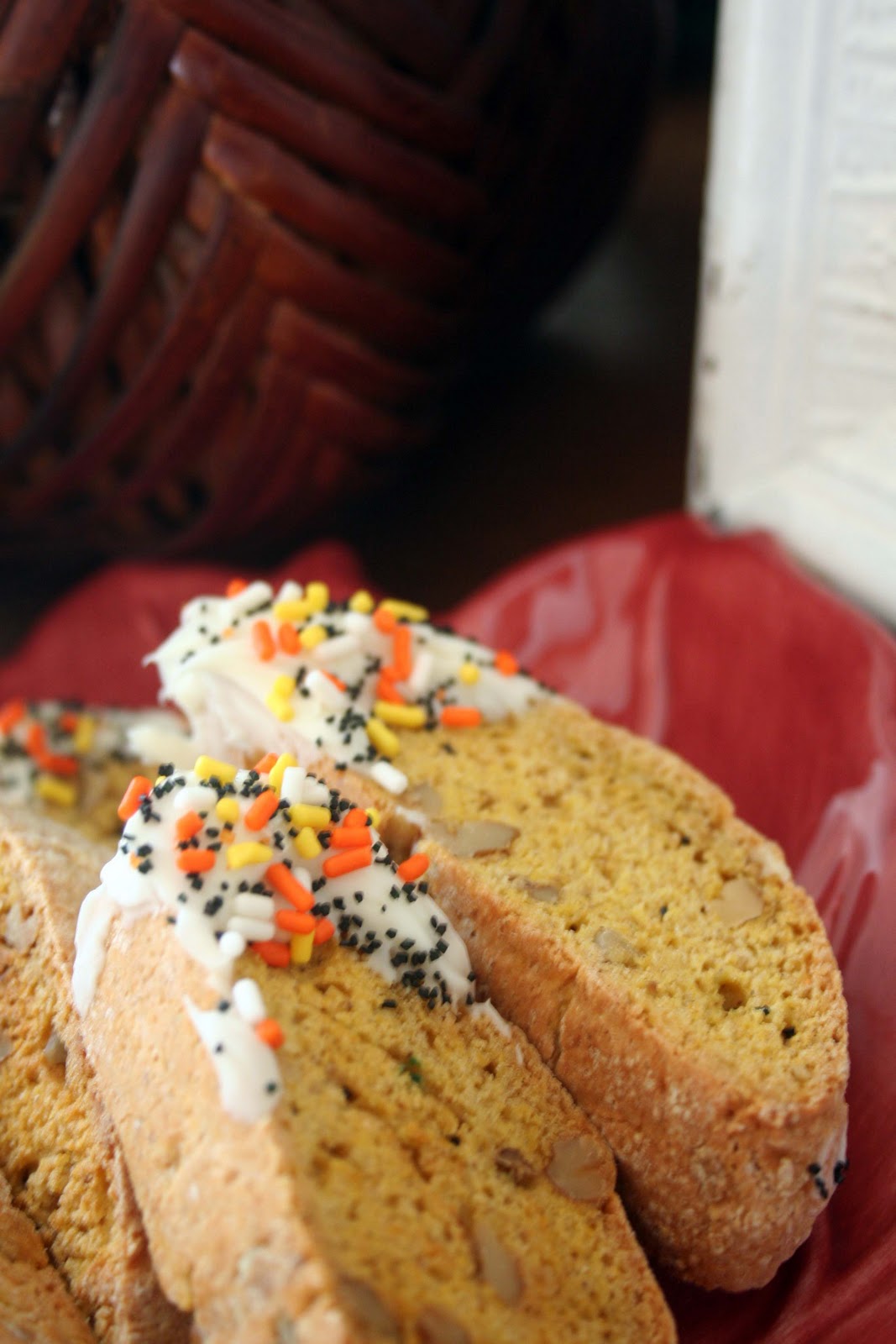
But though it's probably too late for Halloween, today's recipes are perfect through Thanksgiving. They're kind of a two-for-one: one 15 oz can of pumpkin will do for both recipes. Easy to make and easy on the wallet, the recipes are appealing to a wide range of cookie affectionados: those who enjoy a chewy biscuit and those who like a harder variety that 'dunks' well. As I detailed earlier this month, pumpkin is a fantastic, nutritious fruit with so many delicious ways to enjoy it's taste. Give these two a try and rest assured, more pumpkin recipes will follow as we slip and slide toward Thanksgiving!

Pumpkin-Walnut Biscotti
Makes 15-20 cookies

Ingredients2 1/2 cups of flour
1 cup of sugar
1 teaspoon of baking powder
1 teaspoon of cinnamon
1/2 teaspoon of nutmeg
Pinch of ginger
Pinch of cloves
Pinch of salt
2 eggs
1/2 cup of pumpkin purée
1 teaspoon of vanilla extract
1/2 cup chopped walnuts


Directions
  • Preheat oven to 350°F. Sift together the flour, salt, sugar, baking powder, and spices into a large bowl.
  • In another bowl, whisk together the eggs, pumpkin purée, and vanilla extract. Pour the pumpkin mixture into the flour mixture. Roughly stir to mix the ingredients until the dough is crumbly.
  • Fold in chopped walnuts.
  • Flour your hands and lightly knead the dough. Grease a baking sheet or line it with parchment paper. Form the dough into a large log, roughly about 15-20 inches by 6-7 inches. The loaves should be relatively flat, only about 1/2 inch high. Bake for 22-30 minutes at 350 F, until the center is firm to the touch. 
  • Let biscotti cool for 15 minutes and then using a serrated knife cut into 1 inch wide pieces. Turn the oven to 300 F and bake for an additional 15-20 minutes. Cool completely.
  • To crisp the biscotti, let them sit uncovered overnight in a dry space.

Iced Pumpkin, Oatmeal, Chocolate Chip Drop Cookies

Ingredients
2 1/2 cups all-purpose flour
1 teaspoon baking powder
1 teaspoon baking soda
2 teaspoons ground cinnamon
1/2 teaspoon ground nutmeg
1/2 teaspoon ground cloves
1/2 teaspoon salt
1/2 cup butter, softened
1 1/2 cups white sugar
Use rest of pumpkin puree from above recipe (about 1/2 cup)
1 egg
1 teaspoon vanilla extract
1/2 cop oatmeal
1/2 cup chocolate chips

Directions
  • Preheat oven to 350 degrees. Combine flour, baking powder, baking soda, cinnamon, nutmeg, ground cloves, oatmeal and salt; set aside.
  • In a medium bowl, cream together the 1/2 cup of butter and white sugar. Add pumpkin, egg, and 1 teaspoon vanilla to butter mixture, and beat until creamy. Mix in dry ingredients. 
  • Fold in chocolate chips.
  • Drop on cookie sheet by tablespoonfuls.
  • Bake for 15 to 20 minutes in the preheated oven. 
  • Cool cookies, then ice with white chocolate. Add sprinkles before chocolate hardens.

Thursday, October 27, 2011

Halloween Trivia That Tricks and Treats; Goblins and Ghosts and Witches, Oh My; 2011 Most Popular Costumes? Sheen and Snooki


Halloween is not my favorite holiday. Before we were married and after, but before we had kids, my husband and I lived in fear of being invited to a costume party. Both on the same page about dressing up (read that, strong dislike) we came up with stock costumes that we could live with. I was a scarecrow with a red plaid shirt (right out of my closet), jeans (also out of my closet) and a straw hat that was probably a prize from a fair we had attended. Two circles of red on my cheeks and I was done. My husband had a red cowboy-ish woven poncho (actually I think it was an old rug that belonged to his mother and we cut a slit for his head) and a large sombrero (not sure where this came from but somehow it was in our possession) and jeans. No makeup. That was it. Tah-dah.

You can see why it's just not a happy memory for us.

But I suppose I should be grateful that those days are behind us because Halloween of late has been supersized with professional costumes in specialty Halloween stores that dot the landscape, indoor and outdoor house decorations rivaling Christmas. I'm just happy that trick or treating has remained relatively the same.

So if you're a reluctant Halloweener like me, here is some trivia to help you look like you get in the spirit:

Halloween Color Schemes
Orange and black are Halloween colors. Orange is associated with the Fall harvest and pumpkins and black is associated with darkness and death.

Pumpkins r' Us

  • Jack o’ Lanterns originated in Ireland where people placed candles in hollowed-out turnips to keep away spirits and ghosts on the Samhain holiday.
  • Illinois is the leading pumpkin-producing state with an estimated 427 million pounds according to the USDA National Agricultural Statistics Service.
  • Pumpkins are not just orange, they also come in white, blue and green.


Costume Corner
This year the most popular Halloween costumes are Charlie Sheen. Other choices are Lady Gaga, Katy Perry, Snooki from Jersey Shore and Kate Middleton. The most popular costumes of all time are witches, ghosts, cowboys or cowgirls, vampires.

How to make a witch hat
You'll need:
Black construction paper
Scissors
Craft knife
Pencil
Ruler
Compass
Glue
Scotch tape
Stapler
Glitter

Instructions


  • Place the construction paper on the table and put something on each corner to keep it flat.
  • Draw a large circle on the construction paper, using a compass. This will be the width of the hat from one end of the brim to the other end of the brim. Cut out the circle.
  • Draw a second, smaller circle inside the first circle. The small circle should be large enough to fit the wearer's head.
  • Cut out the inner circle, using the craft knife. You now have a round piece of construction paper and a round piece with a hole in the middle for the brim.
  • Draw a line across the center of the round piece of construction paper, using the pencil and ruler. Cut the construction paper in half along the line.
  • Roll the half-circle into a cone shape, with one end wide and the other end coming to a point. Make sure the wide opening fits into the open circle of the brim.
  • Staple together the two ends of the bottom of the cone to hold it together.
  • Glue the cone-shaped construction paper together along the seam.
  • Wait for the glue to dry. When the glue is dry, glue or tape the wide open end of the cone to the brim.
  • Decorate your witch hat. Squirt some glue around the hat and sprinkle glitter on it.


Halloween History
Driud
  • 2000 years ago, the Celts who lived in the northeastern regions of Europe (Ireland, France and the UK) held pagan festivals on last day of October, the last day of the Celtic calendar. They called these festivals Samhain, which translates to "summer's end."It was originally a pagan holiday honoring the dead. Holloween's name  was changed to All Hallows Eve.
  • These ancient peoples believed that the spirits of the dead would rise and cause mischief. The Druids who were their spiritual leaders, would communicate with the dead and predict events of the New Year knowing that many of them would not survive the long winter. The bonfire was a major part of the festival. The Druids would light the fire, and then the celebrants would burn grains and portions of the harvest as tributes. They looked to their religious leaders for guidance. The ancient Celts thought that spirits and ghosts roamed the countryside on Halloween night. They began wearing masks and costumes to avoid being recognized as human. These costumes were most often made from animal hides. 
  • In about 43 AD, the Celts were conquered by the Romans. The Romans had their own rituals to honor and appease the dead which involved Romans visiting gravesites and leaving a number of tributes. The offerings were supposed to include a bit of bead, some salt, a few seeds of grain and a wreath. One of the Roman festivals was known as Feralia. 
  • In 601 AD, Pope Gregory, the 1st issued an edict directing missionaries to use native celebrations and practices to their advantage in order to convert the pagans. The fact that All Saints' Day is celebrated the day-after Halloween is no coincidence. It was a way of drawing attention away from the Celtic rituals held on the last day of October. The missionaries preached that spirits, which were a part of the Samhain rituals, were evil and that those who worshiped them were also evil or devil worshippers. Halloween became associated with evil spirits and the following day, which was the Christian holiday, was associated with the Saints. In another attempt to diminish the popularity of this celebration the Church introduced All Souls Day. This celebration took place on the 2nd of November. 
  • Halloween night in our country is a time of fun and festivities. Most children and some adults get dressed up and go trick or treating. It can also be a time for pranks and parties.
  • Some people think that Halloween is an evil night of devil worship. 
  • Halloween is the 2nd most commercially successful holiday, with Christmas being the first.
Catch Up on Candy
  • Candy corn history dates back to the 1880s when the Philadelphia-based Wunderlee Candy Company's George Renninger invented this popular candy. Wunderlee Candy Company was the first company to manufacture the candy. In 1900, the Goelitz Candy Company, which later became the Jelly Belly Candy Company, started making these candies and continues to make candy corn today.
  • Tootsie Rolls were the first wrapped penny candy in America.
  • Halloween candy sales average about 2 billion dollars annually in the United States.
  • Chocolate candy bars top the list as the most popular candy for trick-or-treaters with Snickers #1.
  • Bobbing for apples is thought to have originated from the Roman harvest festival that honors Pamona, the goddess of fruit trees.
  • According to the U.S. Census Bureau, California leads the nation in the number of chocolate and cocoa manufacturing establishments, with 135, followed by Pennsylvania, with 111.
  • The National Retail Federation estimated consumers in 2010 spent $66.28 per person on Halloween costumes, cards, and candy.
  • Chocolate makes up about three-quarters of a trick-or-treater’s loot, according to the National Confectioners Association.

Scary Stuff
  • Black cats were once believed to be witch's familiars who protected their powers.
  • Signs of a werewolf are a unibrow, hair palms, tattoos, and a long middle finger.
  • Vampires are mythical beings who defy death by sucking the blood of humans.
  • In 1962, The Count Dracula Society was founded by Dr. Donald A. Reed and to this day, there are vampire clubs and societies with people claiming to be real vampires.
  • There really are so-called vampire bats that live in Central and South America and feed on the blood of cattle, horses and birds.
  • Many people still believe that gargoyles were created by medieval architects and stone carvers to ward off evil spirits
  • If you see a spider on Halloween, it is the spirit of a loved on watching over you.
  • Worldwide, bats are vital natural enemies of night-flying insects.
  • The common little brown bat of North America has the longest life span for a mammal it's size, with a life span averaging 32 years.

Best Halloween Movies
  • The Rocky Horror Picture Show
  • The Shining
  • The Silence of the Lambs (right)
  • Halloween
  • Poltergeist
  • A Nightmare on Elm Street
  • Alien
  • Night of the Living Dead
  • The Exorcist
  • Seven
For kids:


  • Casper
  • Ghostbusters
  • Clifford’s Big Halloween
  • Harry Potter and the Prisoner of Azkaban
  • It’s the Great Pumpkin, Charlie Brown
  • Monsters, Inc.
  • Rugrats Halloween
  • Beetlejuice (left)
  • The Nightmare Before Christmas
  • The Witches
Miscellaneous
  • Samhainophobia is the fear of Halloween
  • 90 percent of parents admit to sneaking goodies from their kids’ trick-or-treat bags.

Tuesday, October 25, 2011

Who Said That? 21 Quotes That Challenge; "Old's Not So Bad, But Fat and Old?"


Can you guess who said it?
Photos will give you a clue to five answers but you're on your own for the rest.... hint, the photos are not in any order. Good luck.

1. "A wise girl kisses but doesn't love, listens but doesnt believe, and leaves before she is left."

2. “Give me Liberty, or give me Death!”

3. "I guess I don't so much mind being old, as I mind being fat and old."

4. "Frankly, my dear, I don't give a damn!"

5. "We've all heard that we have to learn from our mistakes, but I think it's more important to learn from successes. If you learn only from your mistakes, you are inclined to learn only errors."

6. "Economic medicine that was previously meted out by the cupful has recently been dispensed by the barrel. These once unthinkable dosages will almost certainly bring on unwelcome after-effects. Their precise nature is anyone's guess, though one likely consequence is an onslaught of inflation."

7. “If you judge people, you have no time to love them."

8. "Determine never to be idle...It is wonderful how much may be done if we are always doing."
9. "There isn't a person anywhere who isn't capable of doing more than he thinks he can."

10. “I have a dream that my four little children will one day live in a nation where they will not be judged by the color of their skin, but by the content of their character.”

11. "Mankind must put an end to war, or war will put an end to mankind. War will exist until that distant day when the conscientious objector enjoys the same reputation and prestige that the warrior does today."

12. "Little League baseball is a very good thing because it keeps the parents off the streets."

13. “A house divided against itself cannot stand.” 

14. "We must become the change we want to see."

15. "Power tends to corrupt and absolute power corrupts absolutely."

16. "I guess the real reason that my wife and I had children is the same reason that Napoleon had for invading Russia: it seemed like a good idea at the time."

17. "The difference between a successful person and others is not a lack of strength, not a lack of knowledge, but rather in a lack of will."

18. "I guess there is nothing that will get your mind off everything like golf. I have never been depressed enough to take up the game, but they say you get so sore at yourself you forget to hate your enemies." 

19. "Anthropology demands the open-mindedness with which one must look and listen, record in astonishment and wonder that which one would not have been able to guess."

20. "What lies behind us and what lies before us are tiny matters compared to what lies within us."

21. "All you need is love."

Answers
1. Marilyn Monroe 2. Patrick Henry 3. Benjamin Franklin 4. Rhett Butler 5. Norman Vincent Peale 6. Warren Buffett 7. Mother Teresa 8. Thomas Jefferson 9. Henry Ford 10. Martin Luther King Jr. 11.John F. Kennedy 12.Yogi Berra 13. Abraham Lincoln 14. Mahatma Gandhi 15. Lord Acton 16. Bill Cosby 17. Vince Lombardi 18. Will Rogers 19. Margaret Mead 20. Ralph Waldo Emerson 21. John Lennon

Monday, October 24, 2011

Forgotten No More: A Happy Day on Staten Island When Trader Joe's Opens It's Doors; Gifting the Guacamole

A Little Less 'Forgotten'
Staten Island is oftentimes referred to as 'the forgotten borough.' Citing lack of a direct subway link to New York City, high bridge tolls and less funding from the city coffers than Queens, Brooklyn, the Bronx and Manhattan, Staten Islanders have been accused of being a bit whiny and actually a lot more. But the claim of being a 'forgotten borough' fades when you consider that many jokes about the Island borough abound. Sorry, there I go whining a bit.

One thing is for sure, though family-centered Staten Islanders love to cook and eat, it has largely been ignored by trendy food chains like Whole Foods, King's, Wegman's and until recently, Trader Joe's.  But after a spring and summer of construction, 'Trader's' finally opened it's doors on Richmond Avenue in the New Springville area of the Island.

Thank you.

I had never been to a Trader Joe's and wasn't sure what to expect. The chain started out as small convenience food stores in the 1950s and were originally called Pronto Market. It was changed to Trader Joe's in 1967 when they opened under that name in Pasadena, California. Lucky friends and family who already had one in their community intimated that it was a place to find organic produce and great prices on their in-house brands of foods and wines...and they were right (though the Staten Island store does not carry wine). What they didn't mention was the friendly service, the open floor layout which made the store easy to navigate and the array of cut flowers and freshly baked breads—two items always on my list. Outside the store, Hawaiian-shirted workers helped load my car....a service I thought was indigenous to Florida only!

But that's not all: Trader Joe's is community friendly. In 2010 the chain donated more than 102,000 gift baskets to community-sponsored events. Did you hear bells while shopping?  Keeping with it's island theme, the store devised this system of communication. Translation: one bell lets staffers know when to open another register. Two bells mean there are additional questions that need to be answered at the checkout. Three bells call over a manager-type person. A store that cares about it's customers? ....music to my ears! Get more information at their website below. 

Not getting into the variety of merchandise, today I'm focusing on one item I purchased and tried out at my family Sunday dinner yesterday. While perusing the produce isle, I came across a small plastic container with ingredients for guacamole dip, a family favorite. I have my own recipe (actually, it belongs to my sister) that I've already written about but I saw other possibilities in the compact package and purchased it for today's blog post. 

The Gift of Guac
If you're lucky enough to be invited as a weekend guest, it's usually appropriate to bring a small house gift. Using the not-too-attractively packaged items, I reworked the idea using a interesting-shaped glass vase I had in the house (the better thing to do would be to purchase a dish to hold the items before and after the preparation. The dish would be gifted to the host or hostess). I wrapped the ingredients in cellophane then tied with a ribbon. I added a sprig of parsley from my garden to decorate the bow. It can be used as a garnish after the guacamole is prepared. If you have a computer, it might be fun to redo the recipe on colored card stock and tie it onto the bow. There are lots of websites out there with templates to help you along. One follows. www.marthastewartweddings.com. Click on 'inspiration' for some ideas.

Preparing the Guacamole
The recipe was easy though in the end I might have added a third avocado to make it less juicy. But the ingredients packaged by Trader Joe's were very fresh and within minutes I had a healthy appetizer to put out before dinner. On a personal note: the jalapeno pepper was a no-go for my family but I tried the  Trader Joe round tortilla chips which were fresh and a great buy with lots of varieties to choose from.

Give the recipe a try, give Trader Joe's a try if you haven't already. If your community is a bit 'forgotten' like Staten Island, send the company a note, you never know!

Trader Joe's Guacamole
Ingredients
Yields 2 cups


Ingredients
2 avocados (I would add one more)
2 roma tomatoes
1 small onion
2 cloves garlic
1 lime
1 jalapeño pepper (didn't use this ingredient)

Instructions
  • Peel and dice the onion and garlic cloves.
  • Combine with diced jalapeño pepper (optional) and avocado. 
  • Mash to desired consistency.
  • Add juice from the whole lime and fold in dice d tomatoes. 
  • Add salt and pepper to taste.