Tuesday, June 14, 2011

Facts About the United States Flag on Flag Day, 2011; Two Teachers Lead the Way; Old Glory 'Goes to the Mattress'!

Flag Timeline
1885: A Wisconsin schoolteacher named BJ Cigrand, had the idea of an annual day to celebrate the United States flag. The Fredonia Public School, District 6 chose June 14 which was the 108th anniversary of the official adoption of The Stars and Stripes, as 'Flag Birthday'. The teacher promoted the observance of the day throughout his life.

1889: A New York City kindergarten teacher named George Balch, planned 'flag day' ceremonies for his students and his ideas were later adopted by the State Board of Education of New York.

June 14, 1891: The Betsy Ross House in Philadelphia held its first Flag Day celebration.

June 14, 1892: The New York Society of the Sons of the Revolution, celebrated Flag Day.

April 25, 1893: Colonel J Granville Leach, historian of the Pennsylvania Society of the Sons of the Revolution, suggested that the Pennsylvania Society of Colonial Dames of America, adopt a resolution requesting the mayor of Philadelphia, others in authority and all private citizens to display the Flag on June 14th. Leach went on to recommend that thereafter the day be known as 'Flag Day'.

May 8th, 1893: The Board of Managers of the Pennsylvania Society of Sons of the Revolution unanimously endorsed the action of the Pennsylvania Society of Colonial Dames.

1894: The governor of New York directed that on June 14 the Flag be displayed on all public buildings. With BJ Cigrand and Leroy Van Horn as the moving spirits, the Illinois organization, known as the American Flag Day Association, was organized for the purpose of promoting the holding of Flag Day exercises.

May 30th, 1916: Inspired by these three decades of state and local celebrations, Flag Day was officially established by the Proclamation of President Woodrow Wilson.

August 3rd, 1949: President Truman signed an Act of Congress designating June 14th of each year as National Flag Day.


Betsy Ross and the Flag
According to sworn affidavits from Betsy Ross' grandson and other family members:  In 1777, Betsy Ross (formerly Elizabeth Griscom), a widower and an upholster, was visited by three men: George Washington, Robert Morris, and George Ross (an uncle of her late husband). Washington had a folded piece of paper in his inside coat pocket which was a sketch of a flag with thirteen red and white stripes and thirteen six pointed stars. Washington asked if Betsy could make a flag from the design. Betsy responded: "I do not know, but I will try."
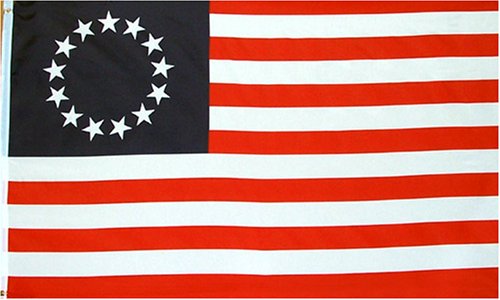
The Betsy Ross flag. 
As the story goes, Betsy suggested changing the stars to five points rather than six. She showed them how to do it with just one snip of her scissors. They all agreed to change the design to have stars with five points. The flag was probably made within the year.

On May 29, 1777, she was paid a large sum of money from the Pennsylvania State Navy Board for making flags.

On June 14, 1777, Congress adopted the Stars and Stripes as our official national flag.

Flag Trivia
Old Glory:  Was a specific flag owned by Captain William Driver made with 24 stars and 13 red and white stripes representing the original 13 colonies: Delaware, Pennsylvania, New Jersey, Georgia, Connecticut, Massachusetts, Maryland, South Carolina, New Hampshire, Virginia, New York, North Carolina and Rhode Island. Old Glory traveled with Driver on his ship and circled the globe twice before retiring with Driver in Nashville. The flag was hidden away inside Driver’s bedspread in Nashville, when Tennessee seceded from the Union. When the war was over, Driver joyously ripped open his bedding to an astonished group of patriots to be proudly displayed for all to see. Sadly, due its fragile state and incredible historical and sentimental value, Old Glory’s last show was at the Tennessee State Museum in 2006. It now lives in the Smithsonian.

Official Colors: Thanks to our friends at Pantone, the red, white and blue stripes are strictly defined as Dark Red (Pantone 193 C), White (Pantone safe), and Navy Blue (281 C).

Current Design: Robert Heft, an 18 year old high school student, designed the flag we know today and was  given a “B-“ for his efforts. The chagrined student challenged his teacher to give him a better grade (an "A")  if his design proposal was accepted by Congress. A presidential proclamation in 1958 officially adopted Heft's design and so he earned the higher grade!

Flag Protocols
  • Our flag should never be “dipped” to any person or thing, except in the case of a naval ship signaling to a foreign country’s ship. 
  • If our flag is harmed in any way, it must be disposed of by burning. 
  • The flag must not touch the ground, but need not be disposed of if dropped by accident. 
  • At night, the flag must be illuminated. 
  • The US flag must not be used on any item designed to be disposable. 
  • There are 6 US flags currently stationed on the moon and were placed there by Apollo 11, 12, 14, 15, 16 and 17. 
  • When folded properly, the US flag is shaped like a triangle with only the stars showing. 
  • It takes 13 folds to fold the flag, the same number of original colonies.
Different flags through the years
  • The original flag had 13 red and white stripes with a Union Jack in the upper left corner. 
  • There was, for a brief time, a US flag with 15 stars and 15 stripes, made to welcome Kentucky and Vermont. This 15 stars and stripes version, however, inspired Francis Scott Key to write “The Star Spangled Banner” in 1814.
  • The US government reverted to the 13 stripe model as the new version of the flag looked too cluttered. 

Monday, June 13, 2011

Coating Salmon Filets With A Maple Syrup, Balsamic, Walnut Glaze Has A Delicious Result: The Ingredients Are All Heart-Smart!


I knew that there were a lot of benefits to eating salmon and now that my family is on a more heart healthy diet, I've discovered that pairing it or cooking with certain ingredients affords a lot more. Not only is salmon high in protein and "good fats" but a 4 oz. serving of wild salmon has a full day's requirements of Vitamin D. A diet rich in Vitamin D promotes better health, longer life, fewer diseases, stronger bones and muscles, fewer infections, less depression, pain and inflammation.

That same 4 oz. piece has more than half of the necessary B12, niacin, and selenium, and is an excellent source of B6 and magnesium. Even if you choose canned salmon, you'll find it contains large amounts of calcium. But the omega-3 fats that are prevalent in salmon, help consumers reduce inflammation in our bodies which causes many health problems including heart disease, diabetes, some types of cancers and arthritis. Omega-3’s also help prevent the formation of blood clots.

A recent development is the discovery that omega-3 fats might help slow Alzheimer’s disease and age-related cognitive decline. Also, people who have sufficient levels of omega-3’s have less depression and suicide risk as well as less aggression.

So with all of that good news in mind. tonight I prepared a salmon dinner using maple syrup and balsamic vinegar as a glaze. Maple syrup, it seems, is a great sweetener to use if you are trying to benefit your heart because it contains both zinc and manganese. Zinc, in addition to acting as an antioxidant, has other functions that can decrease the progression of atherosclerosis and is concentrated more highly in the prostate than in any other human tissue. Low levels of zinc in the prostate relate to a higher risk for prostate cancer. In fact, zinc is a mineral used by health care practitioners to help reduce prostate size. Manganese may also play a role in supporting men's health since, as a catalyst in the synthesis of fatty acids and cholesterol.

I tossed a small amount of walnuts on top and baked it a 350 degree oven for only about 20 minutes. Paired with carrots and peas. it makes a picturesque and healthy spring dinner.

But let's not stop there with health benefits. Incorporating walnuts in your diet reduces the risk of heart disease by improving blood vessel elasticity and the accumulation of plaque. Walnuts have also been shown to aid in the lowering LDL cholesterol (the bad cholesterol) and the C-Reactive Protein (CRP). CRP was recently recognized as a predictor of heart disease.

Enjoy this heart healthy dinner guilt free!!


Maple Syrup, Balsamic 
and Walnut Coated Salmon
For glaze, mix together: 
1/4 cup pure maple syrup
1/4 cup balsamic vinegar
1/4 cup chopped resh walnuts

2 salmon filets (about 3 inches x 6 inches)
salt and pepper to taste

Directions
  • Preheat oven to 350 degrees.
  • lay salmon filets in glass baking pan.
  • Coat top with glaze and let sit for about 1/2 hour.
  • Bake for 20 minutes and serve with vegetables.

Wednesday, June 8, 2011

Fast, Easy and Low-Calorie Filet of Sole; Half-Hour Prep and Cooking Time Yields A Satisfying Meal And Leftovers For Lunch


I arrived home tonight at 7 p.m. but before I left this morning I had taken out 4 frozen pieces of filet of sole purchased fresh last weekend. By 7:35 I was enjoying a light and luscious fish dinner that anyone can prepare. Give this a try if you are on a reduced calorie diet or if you just love fish. Most of the added ingredients and seasonings are in most pantries. I had just enough time to run outside and take a photo while there was still some daylight!

What's nice about this meal is that I had two pieces leftover that will make a tasty sandwich for lunch tomorrow. Take the leftover pieces and use a whole wheat 100 calorie sandwich round available in every supermarket. Load up the sandwich with lettuce, tomato, a slice of red onion or any other garnish you prefer. Add a small dollop of low-fat mayo and you'll have another quick and easy low-cal meal.

What you need
3-4 pieces of filet of sole
1 lemon
Oregano
Lemon pepper
Chopped basil
Olive oil
Pepper, tomatoes for garnish
Mescalin lettuce
Balsamic vinegar


Directions

  • Preheat oven to 350 degrees.
  • While oven is heating, rinse and dry flounder or sole pieces.
  • Place in glass pan and drizzle lightly with olive oil
  • Sprinkle fresh breadcrumbs on fish then lightly sprinkle oregano, lemon pepper, basil lightly over pieces
  • Bake for 25 minutes until fish loses it's translucency.
  • Place on a bed of mescaline lettuce drizzled with balsamic vinegar, olive oil and fresh lemon juice.
  • Top with pepper and slice tomato.

Tuesday, June 7, 2011

Facts About Lead Paint; Judging the "Lead Free is Best For Me" Contest in Newark, N.J., I Educate Myself About This Invisible Problem


Yesterday, I was honored to judge a poster contest for Newark, New Jersey Public High Schools sponsored by Benjamin Moore Paints. The theme was "Lead Free is Best For Me" and the contest was intended to create an awareness that Newark had the highest incidents of lead paint in homes in the state of New Jersey. The students were invited to illustrate the theme and write a mini-essay interpreting the art. There are some pretty hefty prizes to be awarded.

This is the first year the contest was held and the entries were excellent, not only in the execution but also in the written explanation. The finalists have been chosen but because they won't be announced until later in June, I will not show any of the entries here.

Lead paint in homes has devastating effects on residents who many times are unaware that the paint in their homes or apartments contains the element. It is especially harmful to children and for this reason, Benjamin Moore Paint Company teamed up with the Newark Schools to get the message out. All Benjamin Moore Paints are lead free!

Here are some facts and reasons why lead paint is harmful and some suggestions on how to detect and correct the problem if you think you have it.


Lead Paint Facts
  • Lead Paint was banned in U.S. residential paint in 1978. 
  • It was banned in France and many other countries prior to 1920.
  • Three-quarters of the nation's housing contains lead paint. 
  • Lead poisoning is a serious disease. 
  • Children under six are most at risk.
  • Children from every region, race, and socioeconomic level are at risk 
  • Lead poisoning causes learning and developmental disabilities. 
  • There are usually no symptoms. 
  • Even children who appear healthy can have dangerous levels of lead in their blood. 
  • Lead poisoning is preventable. 
  • Most lead poisoning happens at home. 
  • The primary cause is tiny particles of lead dust from deteriorated paint or from painted surfaces disturbed during remodeling, repair or renovation.
  • Lead dust is invisible, so tiny in fact that it passes through most masks & filters.
  • Lead poisoning affects adults as well as kids. 
  • Lead can cause harm wherever it lands in the body.
  • In the bloodstream, lead can damage red blood cells and limit their ability to carry oxygen to the organs and tissues that need it. 
  • Most lead ends up in the bone, where it causes even more problems. Lead can interfere with the production of blood cells and the absorption of calcium that bones need to grow healthy and strong.
How To Detect Lead Paint
  • If your home was built before 1978, have your home tested for lead. The National Lead Information Center (NLIC) provide a list of EPA-certified labs near you. You may send the labs paint chips from cracks for testing. 
  • Do-it-yourself tests, available at hardware stores, can detect high levels of lead, but may not clue you into low levels or lead paint that is under many layers of paint.
  • If lead is found, but the paint is still intact (not chipping or peeling), then your family is safe from lead poisoning. However, if the lead paint is falling apart or was used on door jambs or window frames, where constant movement and friction cause a dust to escape, you will need to take action.

How to Remove Lead Paint
  • If you plan to paint or renovate areas where there is lead paint, you must have the lead paint removed by a lead abatement specialist before starting. If you sand or tear down walls that have lead paint in them, a fine lead-laden dust will disperse throughout your house! Everyone who lives in the house will be exposed to significant risk.
  • A lead abatement specialist (see below) must clean up all lead paint. Do not attempt this yourself! The U.S.Department of Housing and Urban Development (HUD) offices or the American Industrial Hygiene Association can help you locate certified lead removal contractors in your area.
  • As a temporary measure, until lead paint is removed, damp mop frequently to clean up lead-laden dust. Wash children's toys and stuffed animals frequently.
  • If possible, your family should move out while lead-based paint is being removed by a lead abatement professional.
  • The NLIC can provide a list of local specialists who can remove or seal the lead.
The World Health Organization estimates that 15-18 million children in developing countries are suffering from permanent brain damage due to lead poisoning.


        Monday, June 6, 2011

        D-Day By The Numbers: Facts About The Great Invasion on the 67th Anniversary

        U.S. troops approach Utah Beach on D-Day.
        D-Day By The Numbers

        There were 6,603 American casualties on D-Day.

        225 American Rangers landed at Point du Hoc before the invasion occured to take out the large guns that the Germans had on the cliffs that overlooked the beaches.

        Only 25 Australians fought on the beaches but thousands were a part of the airborne invasion. Only about 6 Australians died on D-Day.

        D-Day was originally scheduled for June 5, but the weather did not cooperate. It happened the next day.

        The D-Day invasion involved 5,000 ships carrying men and vehicles across the English Channel.

        A single sortie of two fighters was the German airpower presence over the landing beaches on D-Day.

        The total width of the D-Day invasion front on the Normandy beaches was 61.7 miles.

        Captured Germans were sent to American prisoner of war camps at the rate of 30,000 POWs per month from D-Day until Christmas 1944. Thirty-three detention facilities were in Texas alone.

        800 planes dropped more than 13,000 men in parachutes.

        Wthin weeks after the invasion, supplies were being unloaded at Utah and Omaha beachheads at the rate of over 20,000 tons per day.

        More than 300 planes dropped 13,000 bombs on German troops defending the beaches.

        Over 100,000 Allied troops made it to shore that day.

        War planners had projected that 5,000 tons of gasoline would be needed daily for the first 20 days after the initial assault. In one planning scenario, 3,489 long tons of soap would be required for the first four months in France.

        The Beaches
        The most difficult landing of D Day was at Omaha beach. Navigation problems resulted in many men drowning before they reached land. Omaha Beach also had the largest amount of German troops, and the fighting was fierce.

        The Atlantic wall had been set up by the Germans along the coast of France. It was made up of thousands of large concrete pillboxes set up along the coast of France. Many of the concrete pillboxes were made from material from the beaches and were easily demolished when bombed.

        Nevada Beach was NOT part of the invasion.

        Because the debarkation zones were for the most part directly north to south except on the western end, the morning sun was not a factor.

        Three American divisions, two British, and one Canadian participated in the initial amphibious landings. One additional American and two British divisions followed once beachheads were established.

        Gold, Sword and Juno Beaches were for the Canadian and Britsh Commonwealth to invade.

        Utah and Omaha Beaches were for the Americans to invade.

        There were two main reasons for choosing Normandy as the invasion site: 1. It was less heavily defended than the Pas de Calais. 2. The accessibility to Allied air cover. Allied air domination was essential in establishing a beachhead.

        Utah Beach was added to the attack plan last.

        Omaha Beach battle that is reenacted in the opening of the movie Saving Private Ryan.

        Interesting Facts
        The code name Operation Overlord was given to the military plan for D-Day.

        D-Day was the largest military land invasion ever undertaken during war-time.

        Many soldiers got seasick from the rough ride across the English Channel.

        On the dawn of D-Day, paratroopers secured a vital bridge across the Orne River to prevent German troops from reinforcing the area of the landings. This bridge is commonly known as Pegasus bridge.

        The British 6th Airborne Division landed in gliders a few hundred yards from the bridge and captured it. Today, stone markers indicate the exact location where the gliders came to rest. The operation was code-named Tonga.

        German Field Marshall Erwin Rommel was absent from the action at the onset of the invasion because he was celebrating his wife's birthday in Germany.

        Tthe Allies had barrage balloons which had large steel rods hanging down from them. They tore apart  low flying enemy aircraft above the ships that were firing upon the beaches.

        The Allies trained for D-Day for one year so that they had the toughest and most advanced army for the job.

        The Allies made inflatable tanks and put them in a part of England opposite the Pas de Calais, in order to fool the Germans.

        The 101st Airborne was supposed to take the town of Ste. Marie-Du-Mont but some ended up at Ste. Mere Eglise instead.

        Dummy paratroopers called Ruperts (left) were dropped from other places to confuse the Germans.

        F Company of the 505th Parachute Regiment (82nd Airborne) landed in the town they were supposed to take and were massacred.

        At 0145 hrs, a second platoon of F company, the 505th, had the bad luck to jump right above the town where the Germans were fully alerted. John Steele's parachute was caught in the church steeple and he was hit in the foot. He was deaf for a few days as a result of the church bell ringing. Steele was captured but escaped later.

        Svenner, a Norweigan destroyer, was the name of the only ship sunk by German submarines on D-Day.

        The system that the British used in which they sent false or/and useless information to the Germans was called Double Cross System. The British captured the German spies in Britain, turned them around, and sent useless and misleading information back to the Germans to reinforce the belief that the invasion would be in the Pas de Calais.

        The 'challenge,' the password, and the response of the US paratroopers on D-Day were Flash, Thunder, Welcome. The other alternative to identify oneself was to use the crickets. One was supposed to click the cricket once, click-clack, and the answer would be click-clack, click-clack. 

        By August 1944, all of Northern France was under Allied control as Eisenhower began to prepare for the invasion of Germany.

        Before the Invasion.....
        Before the invasion, the 12,000 planes of the Allied air forces swept the Luftwaffe from the skies, photographed enemy defenses, dropped supplies to the resistance, bombed railways, attacked Germany's industries and isolated the battlefield.

        Before the invasion, the Allies' naval component escorted convoys, patrolled and protected the English Channel, reconnoitered beaches and beach defenses, conducted amphibious rehearsals and organized and loaded a mighty flotilla to land the assault forces in France.

        Before the invasion, the nine army divisions (three airborne and six infantry) from the United States, Britain and Canada trained and rehearsed their roles in the carefully choreographed operation. Rangers climbed cliffs, engineers destroyed beach obstacles, quartermasters stockpiled supplies and infantrymen waded through the English surf as each honed the skills necessary for the invasion's success.

        The Leaders
        The Normandy Invasion Supreme Commander was General Dwight D. Eisenhower, pictured at right.

        The Commander of the 21st Army Group was the General Sir Bernard L. Montgomery.

        Air Marshal Sir Trafford Leigh-Mallory was in charge of the Allied Expeditionary Air Forces.

        Eisenhower appointed Lt. General Walter Bedell Smith as his Chief of Staff.

        Troops Involved in the Invasion
        United States Army 
        First Army
        V Corps
        VII Corps
        1st Infantry Division
        4th Infantry Division
        29th Infantry Division
        82nd Airborne Division
        101st Airborne Division
        UK Land Forces
        Second British Army
        1st British Corps
        30th British Corps
        3rd British Infantry Division
        6th British Airborne Division
        50th British Infantry Division
        3rd Canadian Infantry Division

        Air Forces 
        U.S. Army Air Forces 
        Eighth Air Force
        Ninth Air Force
        British Royal
        2nd Tactical Air Force

        Allied Expeditionary Naval Forces 
        Western Task Force (U.S.
        Eastern Task Force (Britain)

        The Meaning of the "D"
        Many scholars have tried to explain the term “D-Day,” suggesting it stood for “decision day” or “disembarkation day,” but most likely it comes from the army’s use of the term to mean an “undefined day,” or the first day of any operation.

        U.S. troops approach Omaha Beach on June 6, 1944.
        Museums
        The City of Bedford, Virginia is the home of the National D-Day Memorial Complex because
        in that very small town, 21 men were killed on D-Day which was the largest per capita K.I.A. of any city in the United States.

        The National D-Day Museum' is being built in New Orleans, Louisiana in honor of Andrew J. Higgins. Andrew Jackson Higgins, an New Orleans industrialist, designed and built the LCVP's (Landing Craft Vehicles, Personnel)aka 'Higgins Boats'. These landing crafts were vital to the success of Operation Overlord. In 1940 the U.S. had no landing craft. By 1944 the Higgins Industries had built more than 30,000 LCVP's.

        Quotes
        "We want to get the hell over there. The quicker we clean up this Goddamned mess, the quicker we can take a little jaunt against the purple pissing Japs and clean out their nest, too. Before the Goddamned Marines get all of the credit." ~ General George S. Patton, Jr., June 5, 1944

        "Rangers, Lead The Way!" ~ Colonel Francis W. Dawson on the occasion of the Normandy Invasion, 1944

        You will bring about the destruction of the German war machine, the elimination of Nazi tyranny over the oppressed peoples of Europe, and security for ourselves in a free world. Your task will not be an easy one. Your enemy is well trained, well equipped, and battle-hardened. He will fight savagely....The free men of the world are marching together to victory. I have full confidence in your courage, devotion to duty, and skill in battle. We will accept nothing less than full victory. Good luck, and let us all beseech the blessings of Almighty God upon this great and noble undertaking." ~General Dwight D. Eisenhower giving the D-Day order on June 6, 1944.

        Brig. Gen. Theodore Roosevelt Jr.. said "We'll start the war from right here" from a 'headquaters' which was a shell hole. It did not happen.

        London-based American journalist George Hicks made history with his radio broadcast from the deck of the U.S.S. Ancon at the start of the D-Day invasion. "...You see the ships lying in all directions, just like black shadows on the grey sky," he described to his listeners. "...Now planes are going overhead... Heavy fire now just behind us... bombs bursting on the shore and along in the convoys." 

        Thursday, June 2, 2011

        A Yankee Fan Looks Back at "The Sultan of Swat" on June 2, The Day Babe Ruth Retired

        Nat Fein's Pulitzer Prize-winning photograph of Ruth at Yankee Stadium, June 13, 1948 just two months before his death.
        Seventy-six years ago today one of the greatest players in baseball history retired, ending his Major League baseball career after 22 seasons. George Herman Ruth, also known as Babe Ruth, played in 10 World Series games and hit 714 home runs. The Babe was voted into the Baseball Hall of Fame as one of the first five inductees in 1936. The other four Baseball Hall of Fame inductees were Ty Cobb, Honus Wagner, Walter Johnson, and Christy Mathewson.

        Born on February 6, 1895, in Baltimore, Maryland, Ruth attended St. Mary's Industrial School for Boys, where he learned to play baseball and was a top athlete. He was signed by the Baltimore Orioles at the age of 19. The nickname 'babe' came after his teammates and media consistently referred to him as team owner Jack Dunn's newest babe. As his legend grew, he was also referred to as "The Sultan of Swat" and "The Bambino."

        Ruth started his Major League career with the Boston Red Sox as a left handed pitcher in July 1914 and pitched 89 winning games for the team before 1920. When he was traded to the New York Yankees, "the curse of the Bambino," plagued his former team since the Red Sox didn't win another World Series until 2004. As a Yankee, Ruth's position changed to outfielder where he led the Yankees to seven American League pennants and four World Series victories. He had so many fans in New York that when the team opened the new Yankee stadium in 1923, it also became known as "The House That Ruth Built."

        Ruth married Helen Woodford in 1914 but separated around 1926. She died in a fire in Watertown, Massachusetts in 1929. They had an adopted daughter Dorothy Ruth. When the Babe married Claire Hodgson he adopted her daughter Julia. Julia threw out the ceremonial first pitch before the final game in the original Yankee Stadium on September 21, 2008. As a retired couple, Ruth and Claire spent winters in Florida where he had a beachfront home in Treasure Island, Florida, near St. Petersburg.

        Ruth's career ended with the Boston Braves where he was trying to play one last year with the hope of managing the team the next season. The job never materialized probably due to his drinking and womanizing ways. He died of throat cancer August 16, 1948, in New York City. Ruth was just 53 years old and his body lay in state at Yankee Stadium for two days, visited by over 100,000 fans.

        Records and Awards
        • Ruth's 714 career home run record and 40 home runs in each of 11 seasons
          stood until 1974, when it was broken by Hank Aaron. 
        • Ruth's record of 60 home runs in a single season (1927) of 154 games stood until 1961, when Roger Maris knocked out 61 homers in an extended season of 162 games.
        • His career slugging percentage of .690 remains the highest in Major League history.
        • World Series Champion, 1916, 1918, 1926, 1928
        • Led League in home runs 12 times
        • 7-time American League Pennant winner
        • The Associated Press' Athlete of the Century, 1999
        • The Sporting News' Greatest Player of All Time, 1999

        Wednesday, June 1, 2011

        Redoing An Old Baker's Rack; Paint, Tiles and Grout Help to Make a Useful and Attractive Addition to My Backyard Deck

        I had an old, brown baker's rach that had been banished to the garage when our kitchen was redone a couple of years ago.  It became a handy shelving unit for paint and brushes but I had another purpose in mind.

        On our deck, my backyard set is charcoal gray and it's more than a couple of years old. Last year, I purchased a new umbrella, seat covers and pillows from Pottery Barn to give the set a new look. It was then that I thought of redoing the kitchen piece to complement the set and serve as an outdoor buffet. The unit had a bottom shelf and two top shelves in a grill style. The main shelf (at counter height) was wood and was a little beat up. I decided to mosaic tile the wooden piece so that it would wear well in summer and fall weather conditions.

        I  looked in some craft stores for mosaic tiles, but was unable to find the colors I wanted. Then I accidentally came across bags of glass and ceramic tiles in the Christmas Tree shop for the attractive price of $1.00 a bag! Some of the tiles were shell shaped, others flowers or just circular or square. I chose clear, iridescent, turquoise in light and dark shades, spring green and tiny orange tiles, all colors that appear in my backyard cushions and pillows. I needed about 10 bags to fill the shelf so the investment was pretty minimal. It was really a lucky find!


        Painting the piece was easy, tiling more of a challenge. I couldn't locate a charcoal colored spray paint so I had to work with black. I'm hoping time and sun will fade it a bit to look more like the table and chairs. Immediately the piece looked so much better!

        In the evening I worked on the mosaic. I created a centerpiece and corner designs first, then laid out the rest using the variety of pieces to their best advantage. After I had my pattern, I glued each piece in place using a mosaic tile glue available in craft stores. Before grouting, the tiles had to dry for 24-48 hours. I gave it a bit more time to dry and finally got to the grouting part today. I chose a charcoal grout color and followed the instructions on the box but honestly, it wasn't as easy as it sounded and I made quite a mess. One of the problems was that the tiles themselves were at varying heights so when I applied the grout, I had to dig down a bit to expose all of the tiles. My nails will never be the same!

        But upon completion, I was pleased with the result and rushed to put it in place tonight so that I could take a picture. It's not completely dry and not completely cleaned but I hope you'll agree that it's an attractive use of an outdated cast-off. I love the fact that it will hold many of the supplies used during a barbecue and look forward to many deck parties this summer.